St. Louis Mutual Life Insurance Company Building
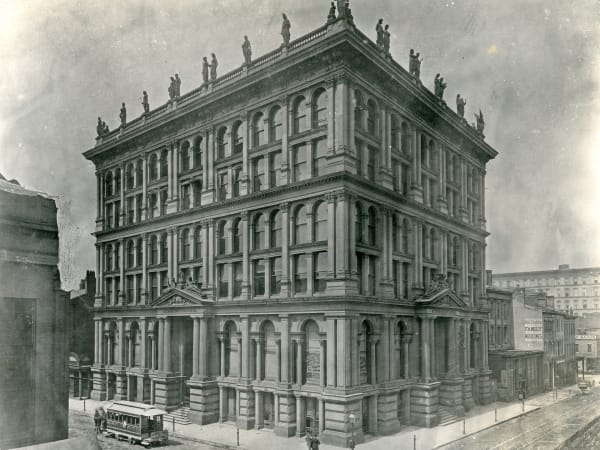
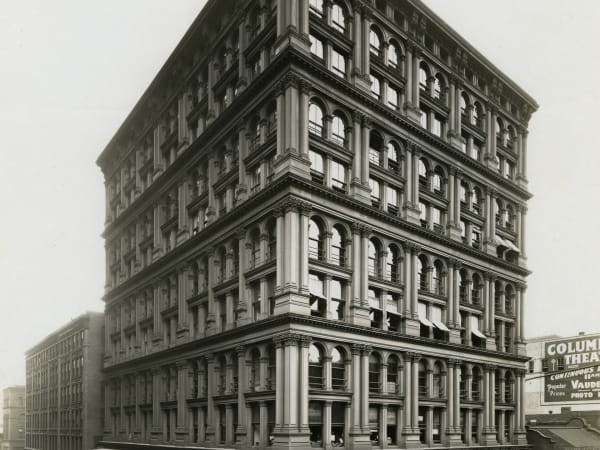
A stone-fronted Renaissance Revival office palace at the northwest corner of Sixth and Locust, built five stories over a raised basement. A ground-floor arcade of round arches between paired columns ran along both streets, broken on each front by an entrance porch under a pediment with reclining classical figures. Above it the upper floors rose in two-story tiers of round-arched windows framed by engaged columns, with heavy cornices between the tiers. A balustrade ran around the roof, and on it stood some two dozen colossal carved statues, with a sculptural group crowning the corner. As the Equitable Building it kept the same arcaded, columned rhythm but rose to about ten stories, with more tiers of arched windows under a plain cornice and no statues. By the 1920s storefronts and awnings filled the ground floor.
The St. Louis Mutual Life Insurance Company built its headquarters at the northwest corner of Sixth and Locust to designs by George I. Barnett. It was finished about 1872 at a cost of some $700,000 and was nicknamed the Palace of Insurance. Its roofline carried 25 colossal stone statues designed by the French-born St. Louis artist Leon Pomarede and carved by seven European-trained sculptors. Henry Marquardt of Stuttgart carved Minerva, and William Ross of London carved Urania, with finishing work by Serephin Cottin of Grenoble. The three stayed on in St. Louis as Henry Marquardt and Co. By the late 1870s the sign over the entrance read St. Louis Life Insurance Co., and after 1881 the building became the Equitable Building, owned by the Equitable life insurance company of New York. In 1884-86 Equitable took down the statues and added five stories. Jay Gould, who had offices in the building, tried to save the statues but could not find a St. Louis institution to take them. Three were later found on the grounds of an estate in Ironton, Missouri, where they had stood since the mid-1880s, and the National Building Arts Center now holds Minerva and Urania. Barnett, Haynes and Barnett, the firm of Barnett's sons, showed the Equitable Building in an 1896 book of their recent work. The building was demolished in 1956, and St. Louis Centre later rose on the site.