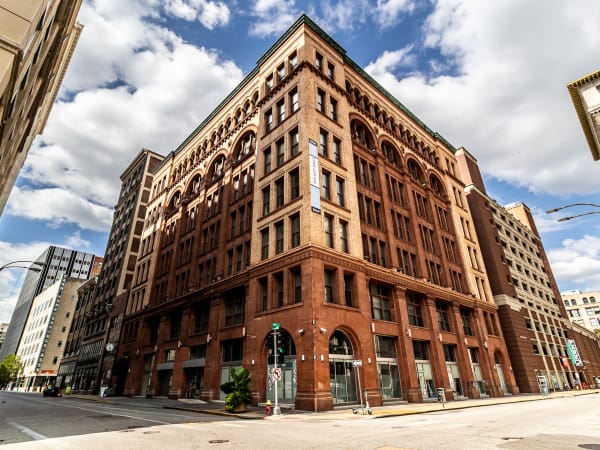
Oscar Enders
Oscar Enders (ca. 1866-1926) was the chief designer in Isaac S. Taylor's office for most of its existence, from about 1890 until Taylor died in 1917, and the largely uncredited hand behind much of its best work. Born in Milwaukee, he took a roundabout path into architecture: he worked as a prestidigitator, a stage magician, with a circus before giving it up for drafting in Chicago. His talent as a designer and perspective artist in the Chicago Architectural Sketch Club caught the eye of Taylor, who lured him to St. Louis in the 1890s. Enders brought with him the Chicago commercial style and an interest in the anti-historicist ideas of the Vienna Secession. Contemporaries credited him with the Planters Hotel and the Board of Education Building, the NRHP nomination for the Hamilton-Brown Shoe Factory attributes its abstract, Secession-inflected detailing to him, and the nomination for the Silk Exchange Building (1901-02) considers him responsible for the firm's output in the years before the World's Fair. He signed many of the office's renderings. He helped establish the St. Louis Architectural Sketch Club and was its president in 1895. When Taylor became Director of Works for the 1904 Louisiana Purchase Exposition, Enders took on even more of the work of the firm. A 1927 tribute in Pencil Points observed that Taylor was always generous enough to credit Oscar as the author of the designs of the period, and Taylor left Enders his architectural library and records. Enders carried on the practice after 1917, then returned to Chicago in the early 1920s, where he spent his last years designing for Graham, Anderson, Probst and White. He died in Chicago in December 1926.