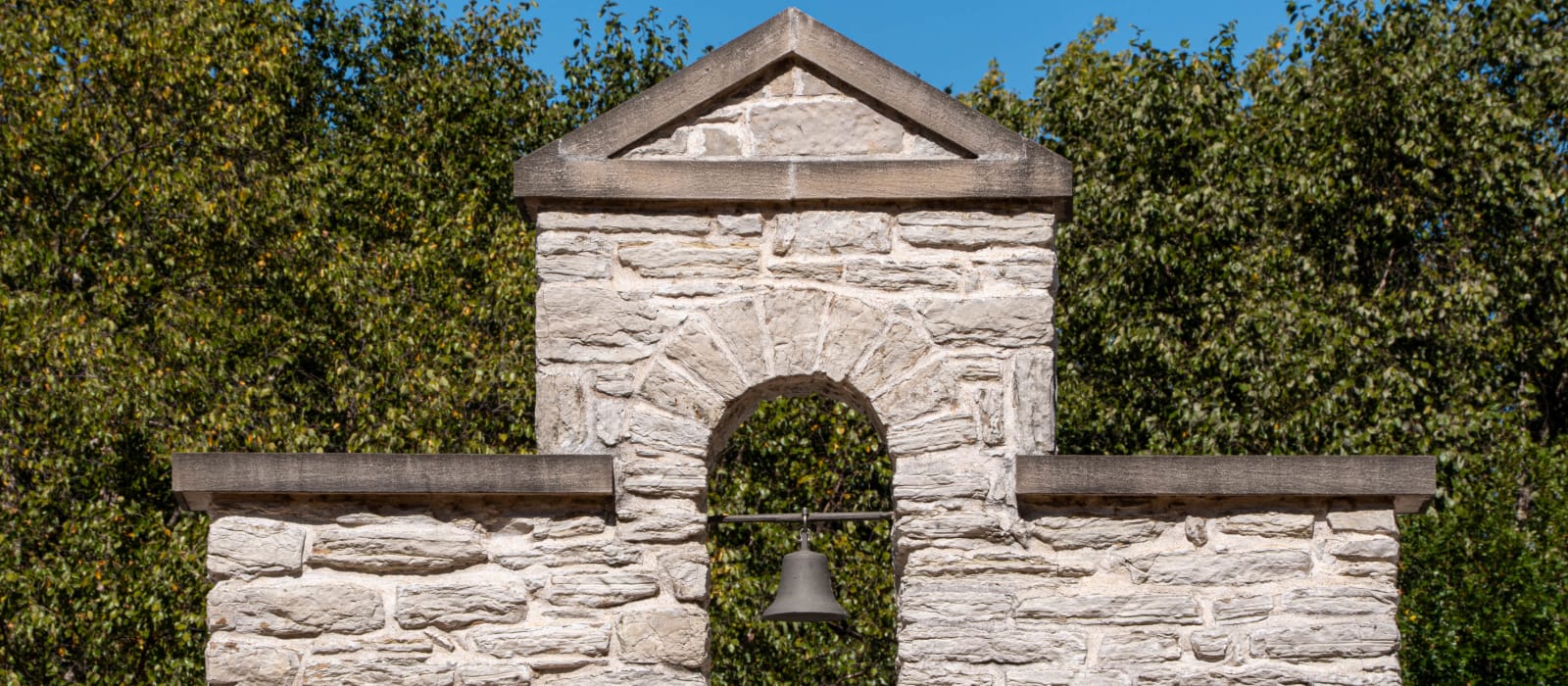
A long, low stable of rough-cut limestone rubble, one story under a flat roof hidden behind a straight parapet capped with stone coping. At the center a stepped stone gable rises above the parapet, opened by a round arch that holds a bell and topped by a small pediment. Below it, a pair of red doors with arched, glazed upper panels fills a round-arched opening, and a row of small, deep-set windows with dark frames and stone sills runs evenly along the front on either side.
The stables went up in the park’s first building campaign, around 1868, as part of a complex with the stone house next door that served the park’s superintendent and later its foreman. Brownlee and Fahey built the house and stable complex for $7,000, and the design is attributed to Francis Tunica. The ten-stall stable was built in the same rustic, coarse limestone as the house, and its central bell gable has been likened to the Alamo. As automobiles replaced carriages, the stables went decades without horses. Around 1998 the park bought two Victorian-style carriages and a horse, and the stables were renovated, with a small office added. They again house the park’s horses, a Clydesdale and a Shetland pony used for carriage rides.


