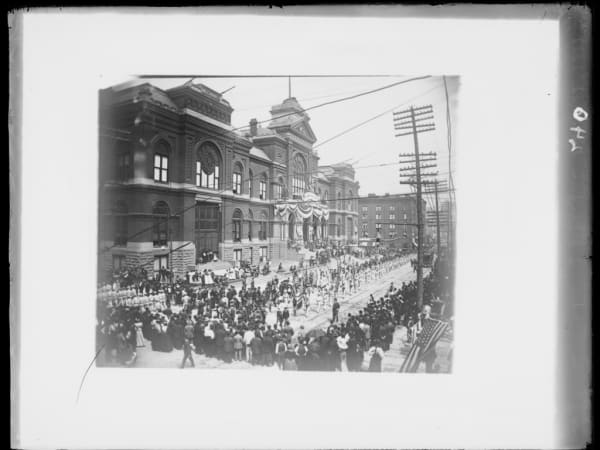
St. Louis Exposition and Music Hall
A block-long exhibition hall, 502 by 332 feet, its long flanks lined with tall round-arched windows above a base of rough-cut stone piers. Projecting pavilions broke the walls at the corners and centers. The central pavilion of the long front held a great wheel window under a parapet lettered MECHANICS, and the principal entrance rose to a gabled tower over an arcaded loggia approached by broad steps, lit by a tall arched window and topped by a flagstaff. Smaller corner towers carried domed lanterns. Inside, the Music Hall seated about 3,500, with a stage that could hold 1,500 performers.
The St. Louis Exposition and Music Hall was built in 1883–1884 on Missouri Park, the public square the Lucas family had given the city in 1854, filling the block of Olive Street between 13th and 14th Streets. Jerome B. Legg won the design competition in 1883, and the building cost about $750,000. It was among the first large halls in the country lit by electricity. For two decades it housed annual expositions and fine art exhibitions, and its Music Hall was the home stage of the St. Louis Symphony Orchestra and a regular stop for the Sousa Band. It held three national political conventions: the Democratic conventions of 1888, which renominated Grover Cleveland, and 1904, and the Republican convention of 1896. A separate Coliseum arena was added to the complex after 1896. The whole complex was torn down ca. 1907, and the site was cleared by October 1908. The southern two-thirds became the Central Library, opened in 1912 with funds from Andrew Carnegie. Locust Street was extended through the block, and the northern part was restored as green space and renamed Lucas Park.