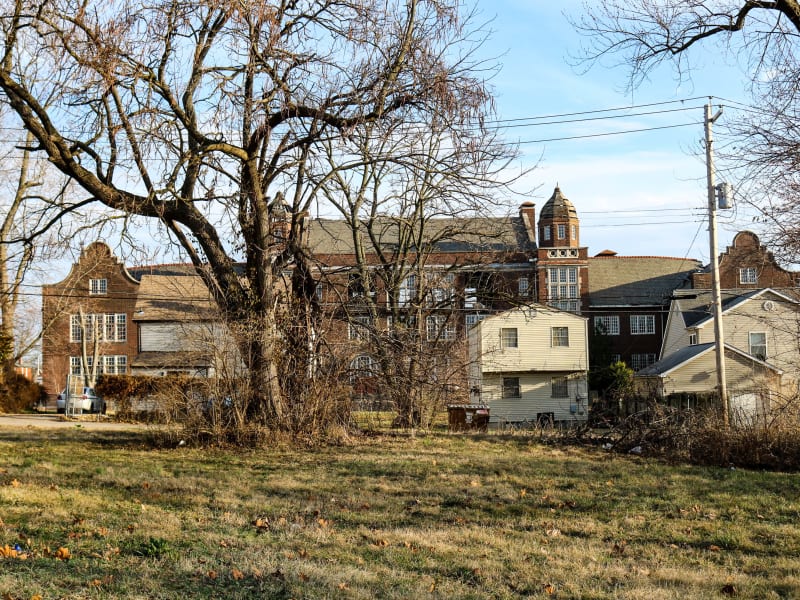
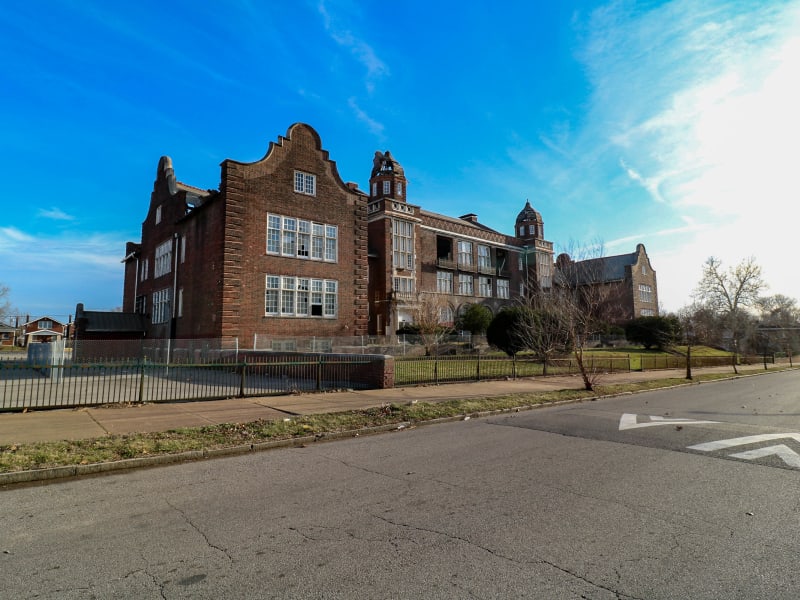
A three-story red-brick school of 1912, designed by William B. Ittner in an elaborate Jacobethan and Flemish Renaissance manner and arranged around an open courtyard, its projecting wings drawing daylight into the classrooms from three sides. Octagonal brick cupolas with domed roofs rise over the central block between Flemish shaped-and-scrolled gables, above a ground-floor arcade of round-arched, stone-trimmed windows and third-floor open-air loggia porches with iron railings. Tapestry brickwork in diamond-diaper bands covers the walls, and the towers and entrances carry vivid polychrome glazed terra-cotta — heraldic medallions and a narrative panel of Columbus's voyages. Long abandoned, the building now stands partly roofless, its domed cupolas collapsing and its windows broken behind a chain-link fence.
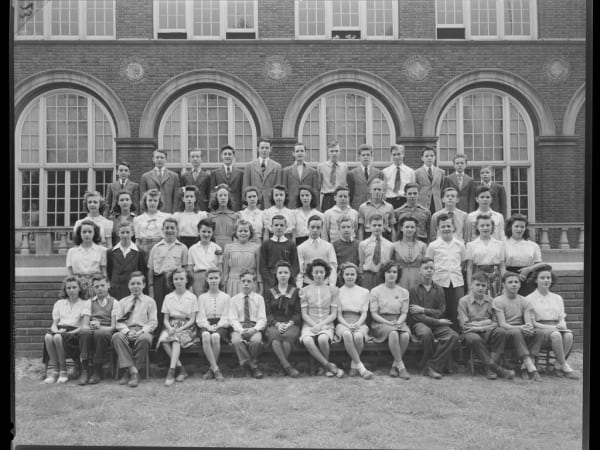
Mark Twain School opened in September 1912 in the growing far-north-side neighborhood then called Harney Heights, and it first bore that name. It was designed by William B. Ittner, the St. Louis Board of Education's Commissioner of School Buildings, as one of his "open-plan" schools — classrooms ranged along single-loaded corridors and projecting wings so daylight and air reached them from three sides, a health-minded ideal echoed in its open third-floor porches. In 1918 the school was renamed for the writer Mark Twain, and the surrounding neighborhood in turn came to be known as Mark Twain. For most of the twentieth century it anchored the community, its brick cupolas and glazed-terra-cotta ornament — among them a panel of Columbus's voyages and heraldic medallions — a point of local pride. The St. Louis Public Schools eventually closed the building as enrollment on the north side fell, and it has since stood vacant, its roof and cupolas failing and its windows broken. Redevelopment into affordable housing has been proposed, but for now one of Ittner's most richly ornamented schools remains an endangered ruin.