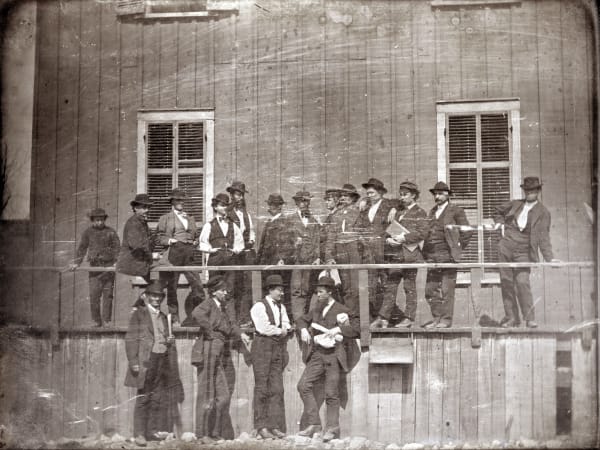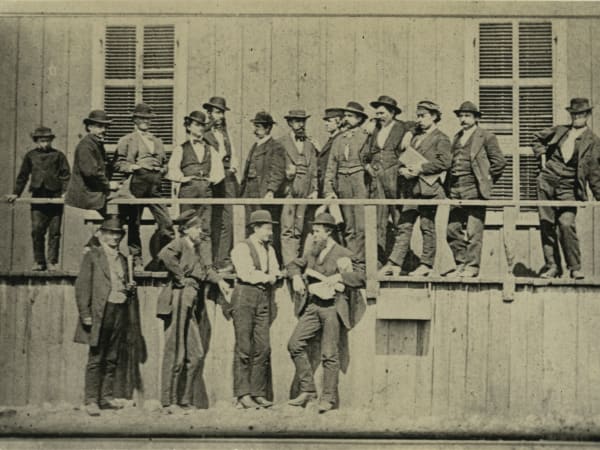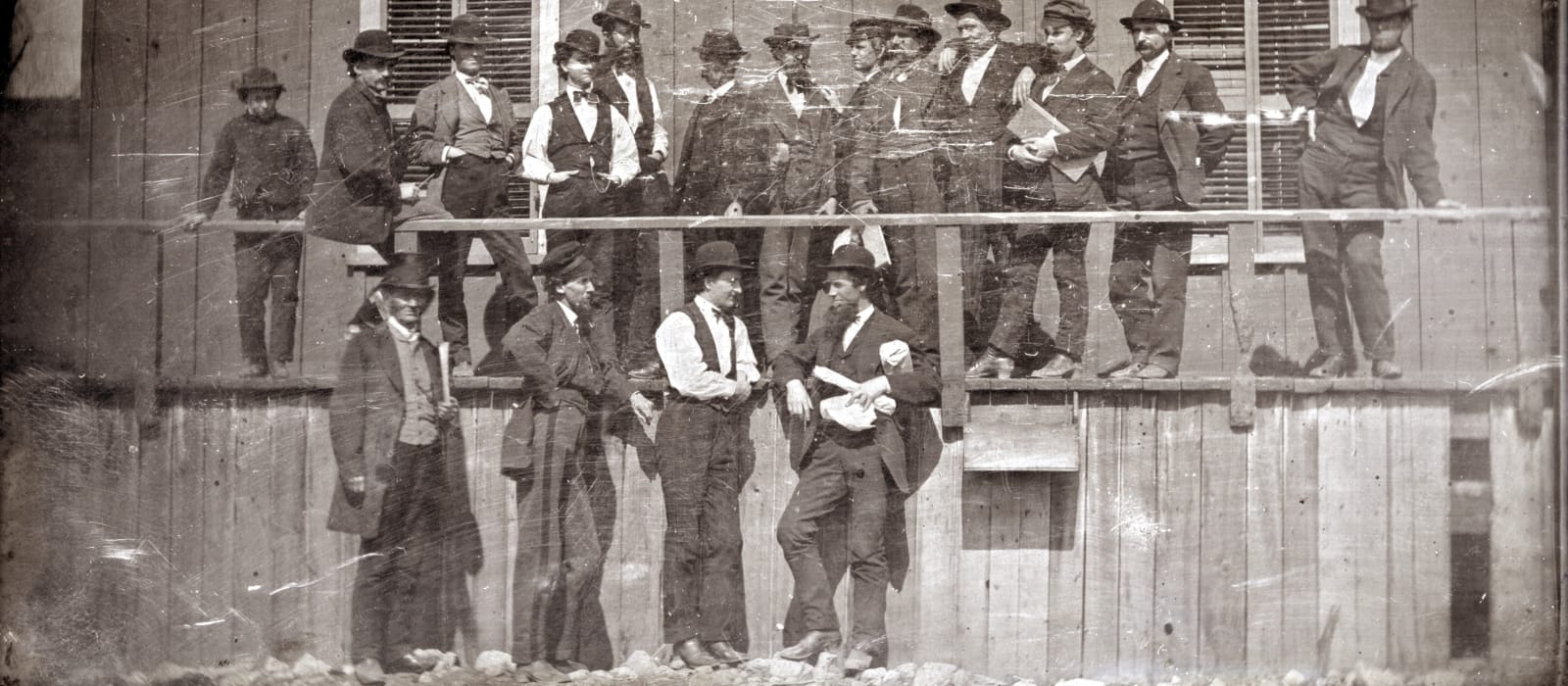
A frame building sheathed in wide vertical boards, its upper wall pierced by tall windows closed with louvered shutters. A raised plank platform with a plain wooden rail ran along its front, boarded down to the ground, with a small hatch in the boards. In 1852 a group of white men in frock coats and hats posed on and below the platform for the camera.
Bernard M. Lynch ran his slave pen on Locust Street, between Fourth and Fifth streets, from at least the early 1850s until about 1859. In the street numbering of the time it stood at 100 to 109 Locust; Lynch gave his address as 104 Locust Street in a letter of January 1853. He held enslaved people there for sale and on behalf of their enslavers, including people captured after escaping. A placard of his rules, dated January 1, 1858, and posted in his office, charged 37½ cents a day for each person's board and 2½ percent on every sale, and declared that he would not be held responsible for escapes or "accidents." The 1859 city directories listed Lynch as one of two slave dealers in St. Louis. In 1855 Esther, who was enslaved by Henry Shaw, escaped across the Mississippi with her children and Jim Kennerly. Lynch captured her in Illinois and charged Shaw $100 for her capture and return, on a receipt dated May 21, 1855. She was held in Lynch's pen for 70 days before Shaw sold her to Vicksburg, Mississippi, apart from her children. Thomas M. Easterly photographed the pen in 1852, the only known photograph of Lynch's business. About 1859 Lynch moved to a larger building at Fifth and Myrtle streets, which the U.S. Army seized in 1861 and used as the Myrtle Street Prison. When the Locust Street building came down is not known. Its site is likely within the block now occupied by the Federal Reserve Bank.