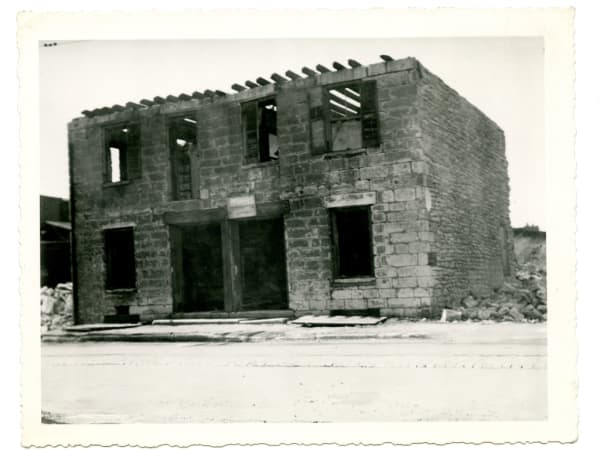
A two-story stone dwelling built in 1829 by fur trapper Jean Baptiste Roy on land purchased from Pierre Chouteau Jr. The oldest surviving residential structure in St. Louis at the time of its demolition, it stood as a direct link to the city's founding generation of French Creole settlers and fur traders.
Jean Baptiste Roy built this house in 1829 on South Second Street on land he purchased from Pierre Chouteau Jr., one of the founding families of St. Louis. Roy was a fur trapper and explorer, and the house reflected the Creole vernacular building traditions of the city's earliest period. By the time the Jefferson National Expansion Memorial was proposed in the 1930s, the building had stood for over a century on the southern edge of the original city plat. The massive 1939–42 clearance of 37 blocks for the Arch grounds left the Roy House temporarily standing at the edge of the demolition zone. With the surrounding neighborhood gone, public interest in the building waned, and owner A.L. Browne ordered its demolition. Architectural historian Kenneth J. Conant, president of the Society of Architectural Historians, toured the house in January 1947 and declared it worthy of restoration: "It is part of the birthright of the city. You will be surprised how elegant a restoration would be made of this building." The St. Louis Star-Times and Missouri Historical Society director Charles van Ravenswaay also intervened, but demolition proceeded on March 31, 1947. Lee Hess, of Cherokee Cave fame, purchased the building stones with plans to reassemble them, but those plans collapsed and the remains were scattered.