City Jail (Sixth and Chestnut)
A blocky stone jail of rough-cut gray ashlar, about three stories under a gabled roof with a pair of chimneys, at the southeast corner of Sixth and Chestnut. Small windows pierce the thick walls, the lowest tier fitted with iron grilles, and wooden fences and lean-to sheds crowd its base. It is a plain, fortress-like structure — without the ornament that later St. Louis jails would use to soften their look.
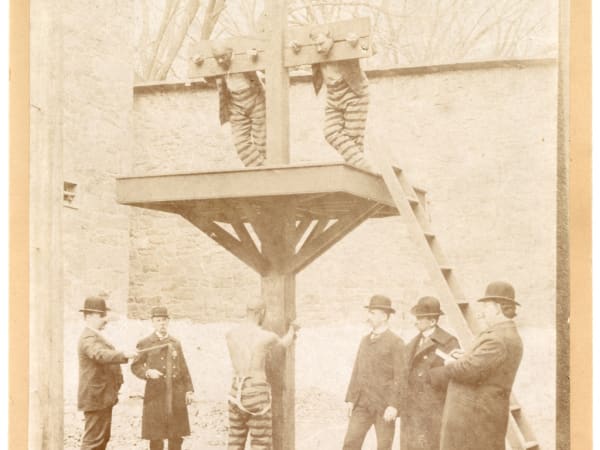
The stone City Jail stood at the southeast corner of Sixth and Chestnut, less than a block from the Old Courthouse — the first St. Louis jail of which a photograph survives. It was already in use by 1840, when the Niles' National Register reported nine prisoners escaping on July 29, and executions by hanging were held there by 1844. Its security was a running joke. The locks were so poor that a burglar once picked his cell, walked quietly out the front door, and was recaptured only because he ran into a jailer on the way to work — a story that traveled as far as the New Orleans Times-Picayune. As the city's population climbed through the 1840s and 1850s, the jail and the separate city calaboose filled past capacity. As the city's main jail it was superseded around 1871 by Thomas Waryng Walsh's Four Courts, but the stone building stood well beyond that: a photograph from around 1890 records prisoners in pillories and a man being lashed in its yard. It was demolished at an unknown later date. The jail survives in a handful of images — Thomas M. Easterly's 1850 daguerreotype, a Boehl & Koenig view of 1870, and the ca. 1890 punishment scene.

![ST. LOUIS JAIL. [OLD CITY JAIL].](https://res.cloudinary.com/dr9qb0oc7/image/upload/w_600,h_450,c_fill,q_auto,f_auto/v1784162215/historical/city-jail-sixth-and-chestnut/N33476.jpg)