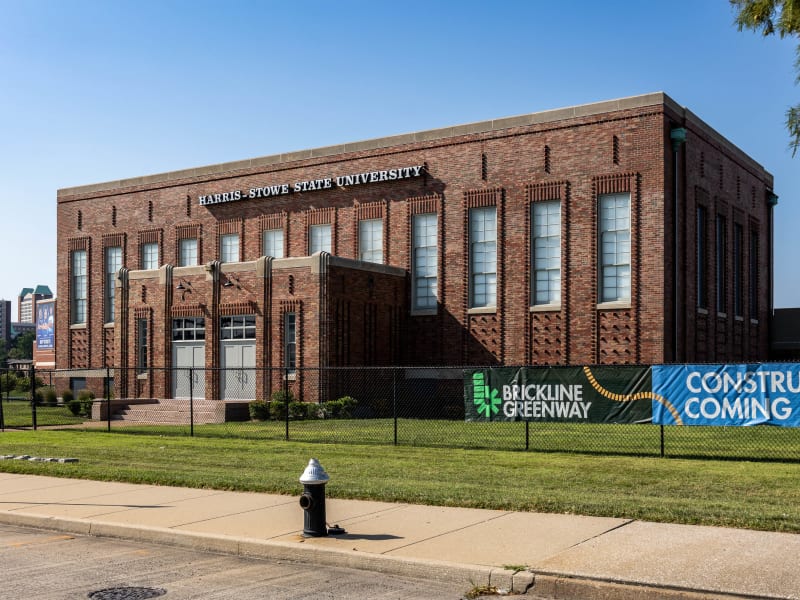
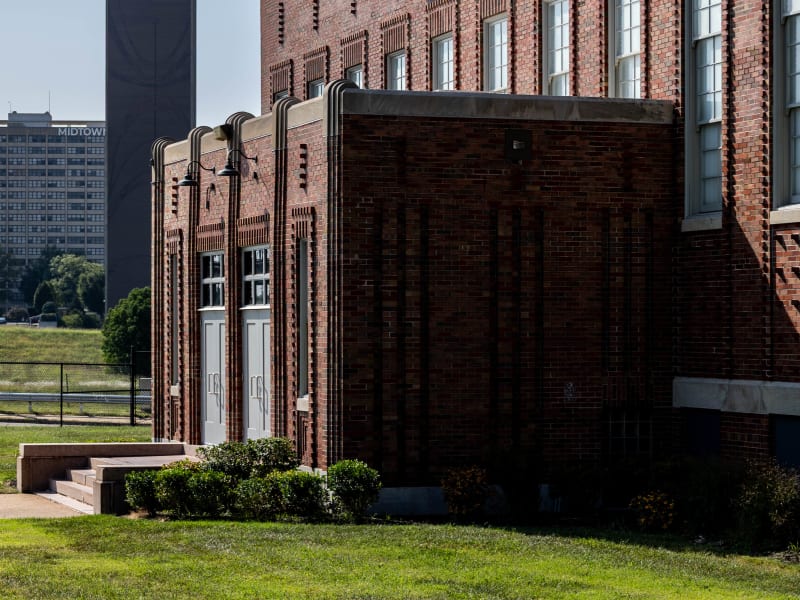
The Vashon Community Center is a one-story, flat-roofed building in a restrained Art Deco style, roughly 100 feet wide, 75 feet deep, and 30 feet tall. A four-bay entrance hall projects from the brick-pilastered south facade, its bays divided by stacked header bricks that rise to carved limestone caps and coping. The main block behind holds the gymnasium over a raised basement; a limestone watertable wraps the building, doubling as the sill line for the basement windows and the lintel for the tall, narrow gymnasium windows above, each framed by projecting and recessed header bricks. A shorter one-story wing extends across the rear wall, and a lighted "Harris-Stowe State University" sign sits within the brick parapet.
St. Louis funded the Vashon Community Center through a 1934 city bond issue and a grant from the federal Public Works Administration, one of four recreation centers — with the Gamble Community Center, Carver House, and Tandy Community Center — built on playgrounds the city had turned over to its Black residents in the early 1930s. Albert A. Osburg was the architect and William C. E. Becker the engineer. Construction finished in 1936, but the building sat unfurnished and unequipped for eight months, a delay the St. Louis Urban League's John T. Clark attributed to city officials who, he said, "hate to see Negroes get anything to which they are rightfully entitled." The $100,000 center opened to the public on October 22, 1937, at Compton Avenue and Market Street, with a dedication dance and a program of volleyball, basketball, softball, and craft work. The center held a gymnasium with a basketball court on the first floor, and locker rooms, showers, restrooms, and a "great room" in the basement; an outdoor pool on the grounds drew neighborhood children in the summer. It survived the city's clearance of Mill Creek Valley, which began in 1959. Harris-Stowe State University purchased the building from the city in 1999, and it was listed on the National Register of Historic Places on August 11, 2005. The National Park Service awarded a $1 million grant in 2009 for exterior stabilization, and Harris-Stowe completed a $3 million renovation that reopened the building on April 11, 2023, as home to the Don and Heide Wolff Jazz Institute, the National Black Radio Hall of Fame, and a repository of papers from William Lacy Clay Jr., Frankie Muse Freeman, and Henry Givens Jr.