Robison Field
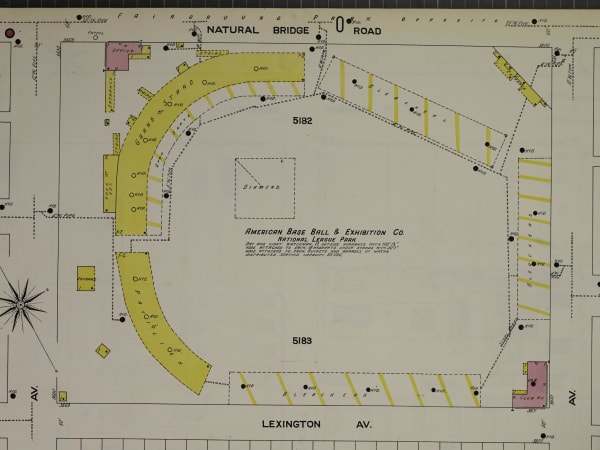
A wooden ballpark filling the two blocks between Vandeventer and Prairie avenues south of Natural Bridge Road, with Palm Street closed through the grounds. A curved frame grandstand, about 27 feet tall, wrapped home plate in the northwest corner at Natural Bridge and Vandeventer, with open seats along its inner edge and a pavilion continuing south along the Vandeventer side. Long open bleachers ran along Natural Bridge, down the Prairie Avenue side and across the Lexington Avenue end, with a scoreboard at the southeast corner. A small brick office and the main entrance stood at the Natural Bridge corner. By 1909 the stands held about 20,000.
Chris von der Ahe, owner of the St. Louis Browns, leased the estate of the late real estate man Jesse G. Lindell at Natural Bridge Road and Vandeventer Avenue in April 1892 and built a new ballpark there to plans by the St. Louis firm of Beinke & Wees. It opened on April 27, 1893, as New Sportsman's Park, before a crowd of about 12,230. On April 16, 1898, fire broke out during a game against Chicago and destroyed the grandstand and the left-field bleachers; at least 100 people were badly burned and one died. The loss helped push von der Ahe into bankruptcy, and the club passed to Frank and Stanley Robison, who renamed it the Cardinals. Reporters called the grounds League Park, and from about 1900 they were Robison Field. J. L. Wees planned the rebuilding. A second fire in May 1901 destroyed the grandstand, pavilion and office, and the Robisons rebuilt again. They bought the land from the Lindell estate for $60,000 in 1906, and steel-and-concrete extensions in 1909 raised the capacity to about 20,000. Known as Cardinal Field by 1918, it saw its last Cardinals game on June 6, 1920, when the team moved to Sportsman's Park at Grand and Dodier. The St. Louis Board of Education took the grounds in 1922, and Beaumont High School was built on the site.