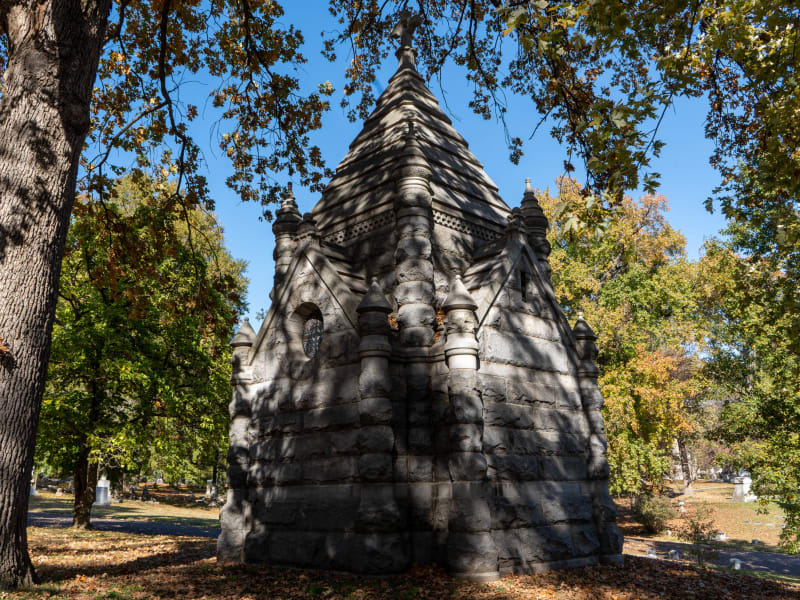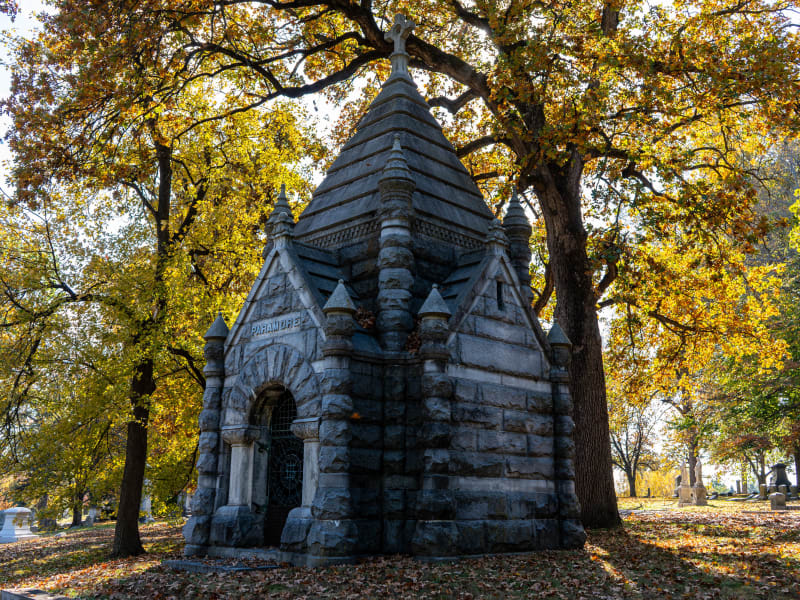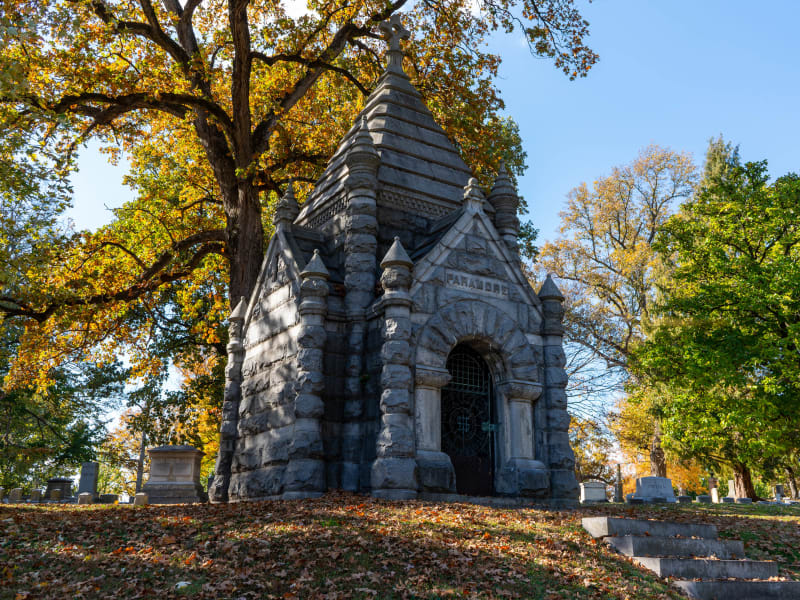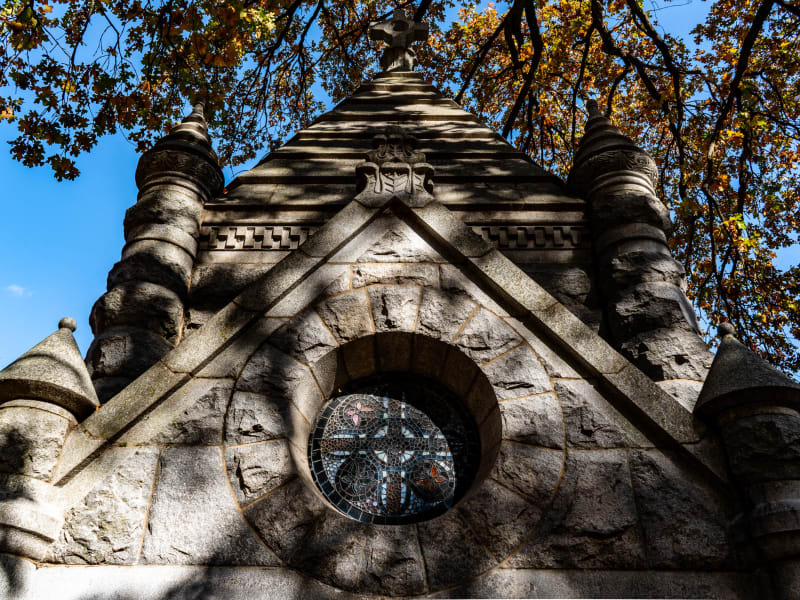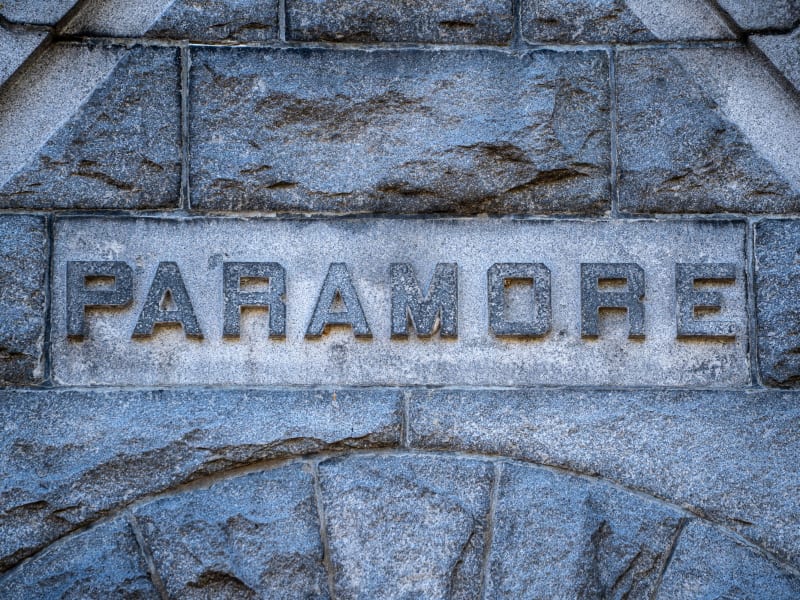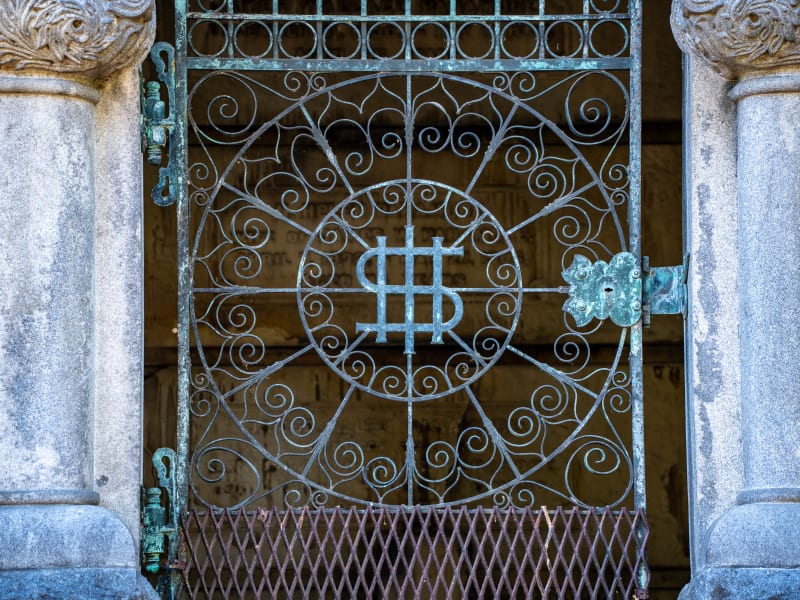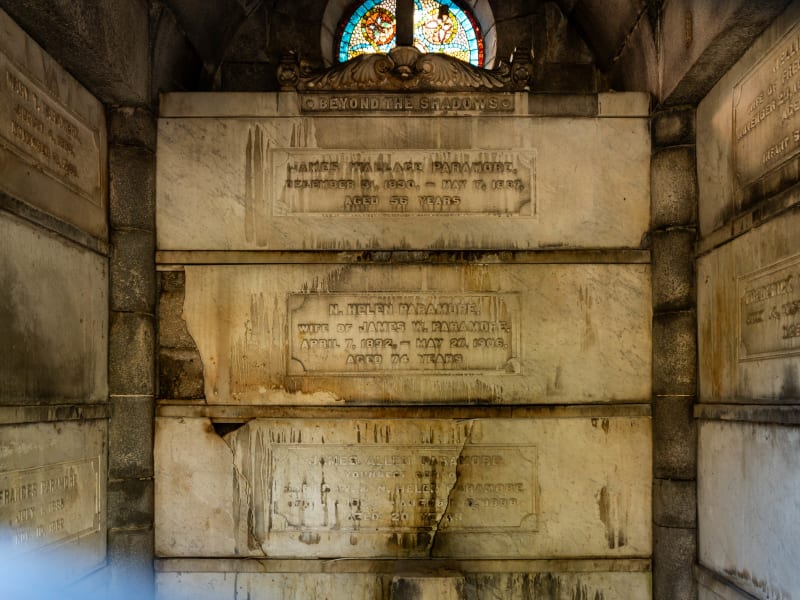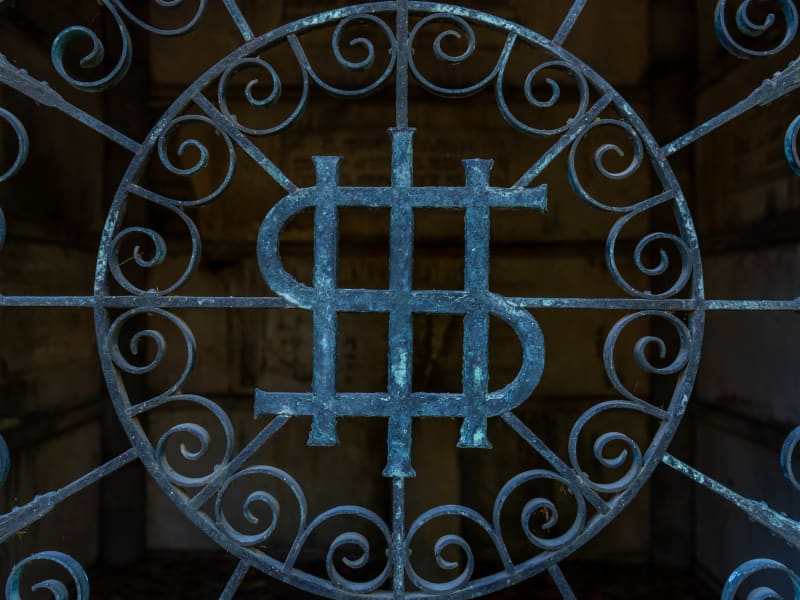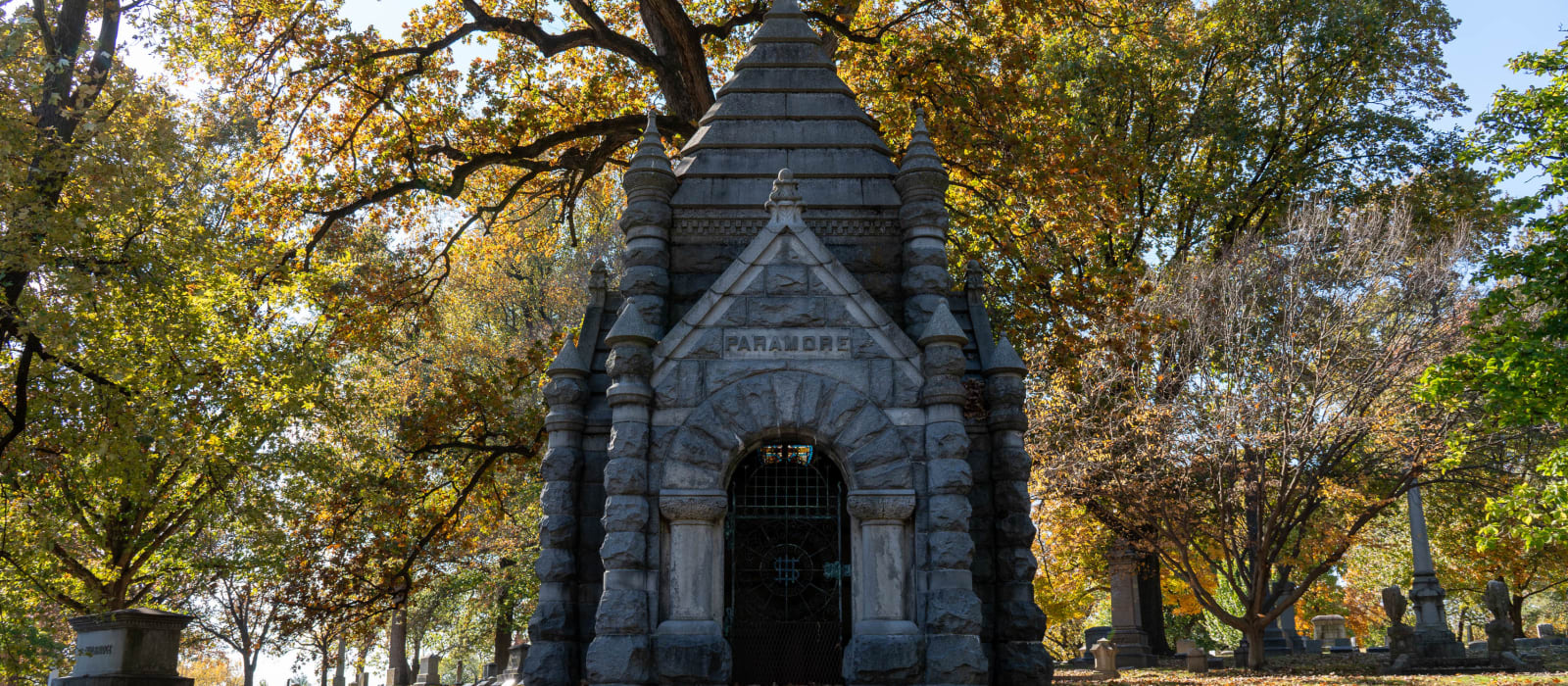
A tall mausoleum of rock-faced gray granite in the Romanesque manner. Round turrets of stacked, rough-cut drums stand at the corners and flank the front, each ending in a smooth conical cap with a finial, and a steep stepped pyramid forms the roof. The front gable carries PARAMORE on a smooth panel. Below it, a round arch of heavy rough-faced voussoirs springs from smooth columns with carved capitals over the entrance, reached by a short flight of steps and closed by a wrought iron gate of scrollwork, with a large dollar sign in a ring at its center. The rear gable holds a round stained glass window. Inside, the white marble crypt fronts sit under a band lettered BEYOND THE SHADOWS.
The family mausoleum of James Wallace Paramore (1830-1887) and his wife, N. Helen Paramore (1832-1906). Paramore, born in Mansfield, Ohio, served in the Civil War with the Third Ohio Cavalry and afterward ran the Tennessee and Pacific Railroad as general superintendent. In St. Louis he helped organize the St. Louis Cotton Compress Company to draw Southwestern cotton through the city, then left it to build a direct rail line to Texas. He persuaded his associates to buy the narrow-gauge Tyler Tap Railroad, which became the Texas and St. Louis Railway in 1879; Paramore was its financial agent and, from 1880, its president, and was known as the "Narrow Gauge King." The line is an ancestor of the Cotton Belt. Paramore died on May 17, 1887. Inside the mausoleum, the white marble crypt fronts sit under a band reading BEYOND THE SHADOWS.