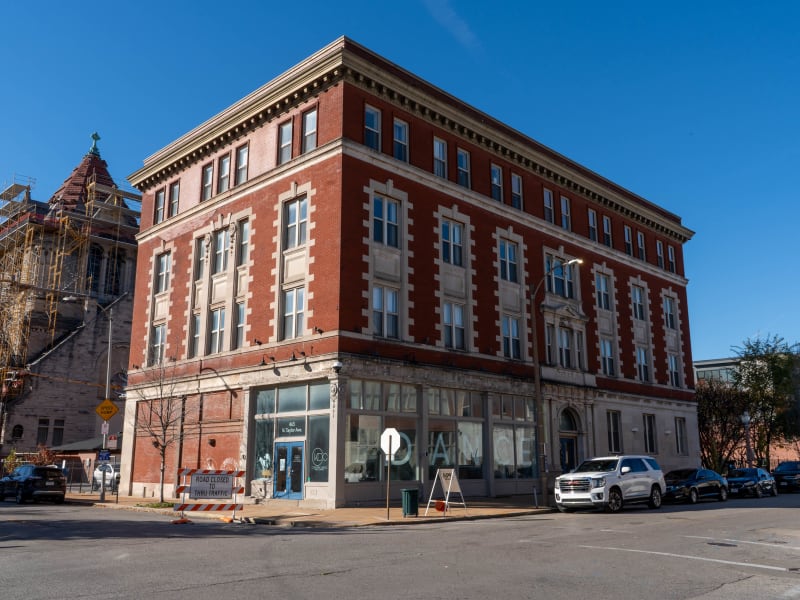
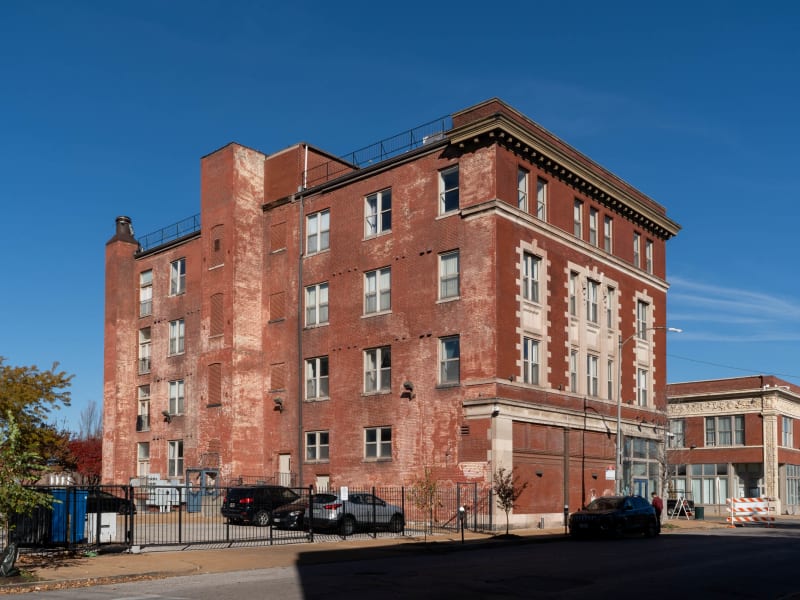
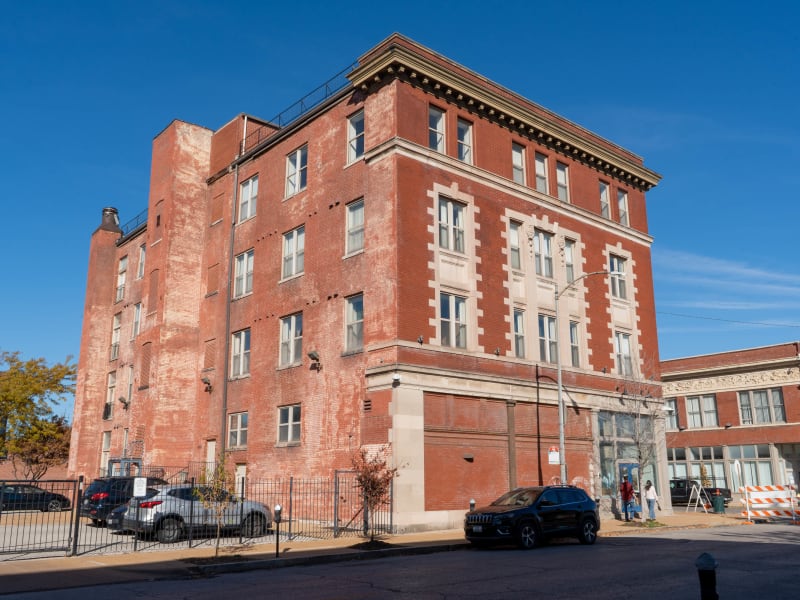
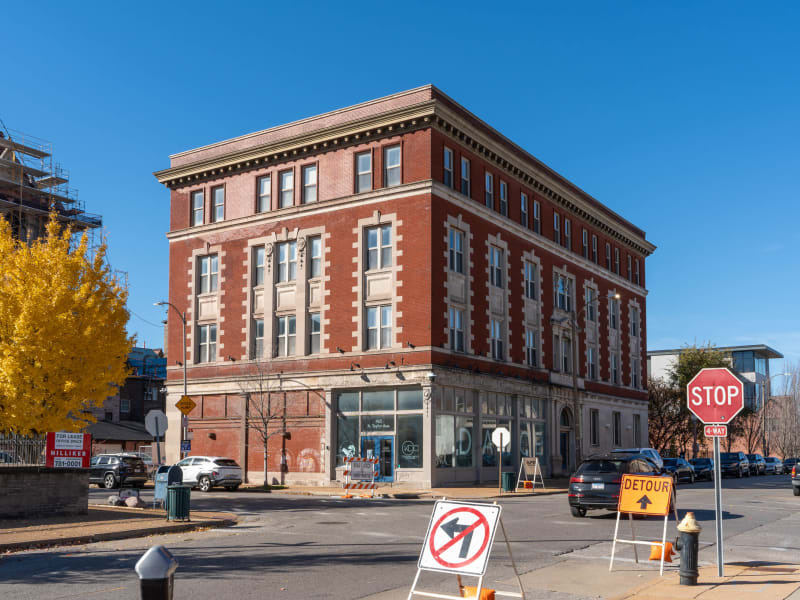
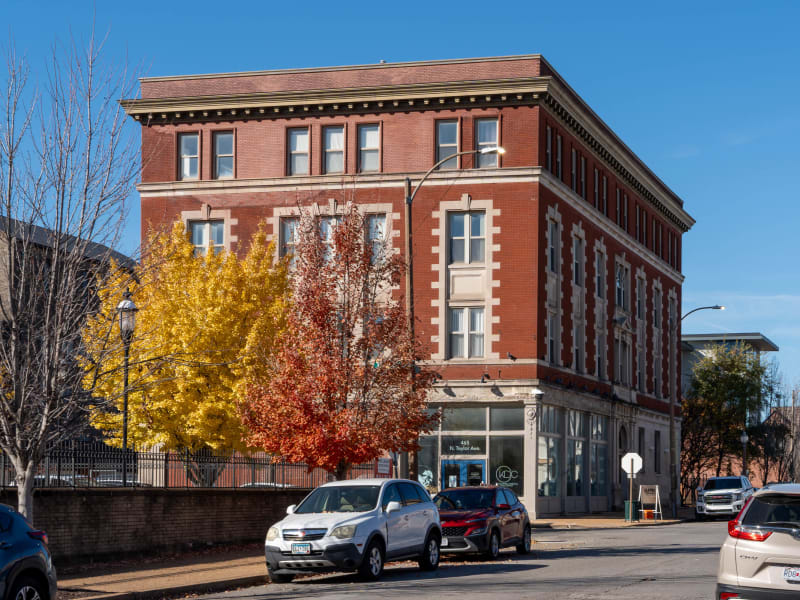
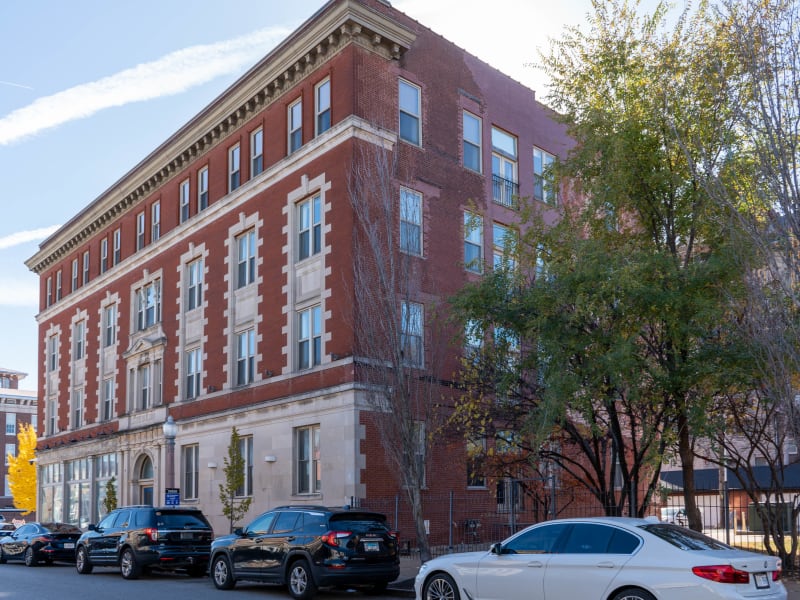
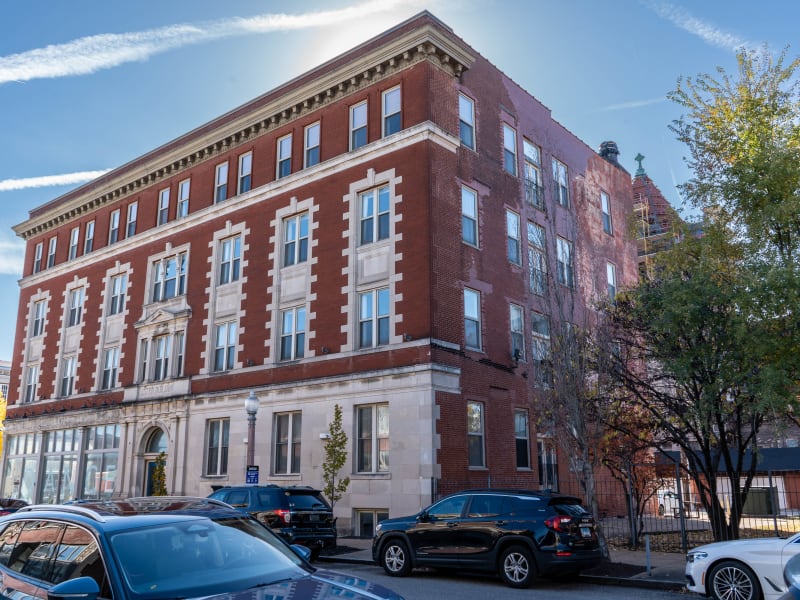
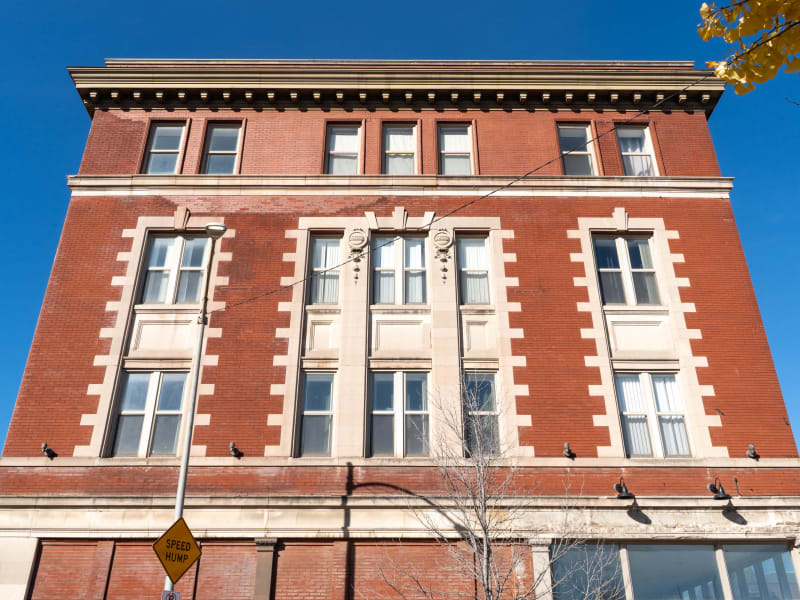
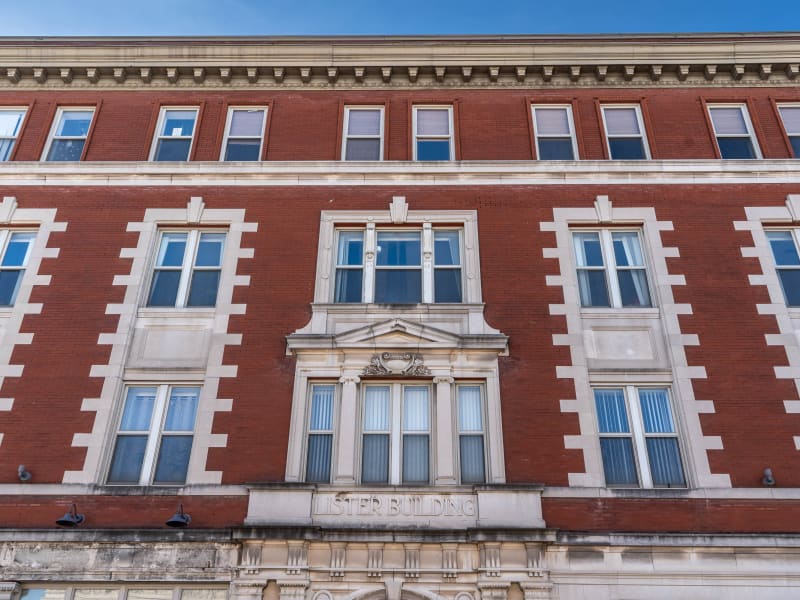
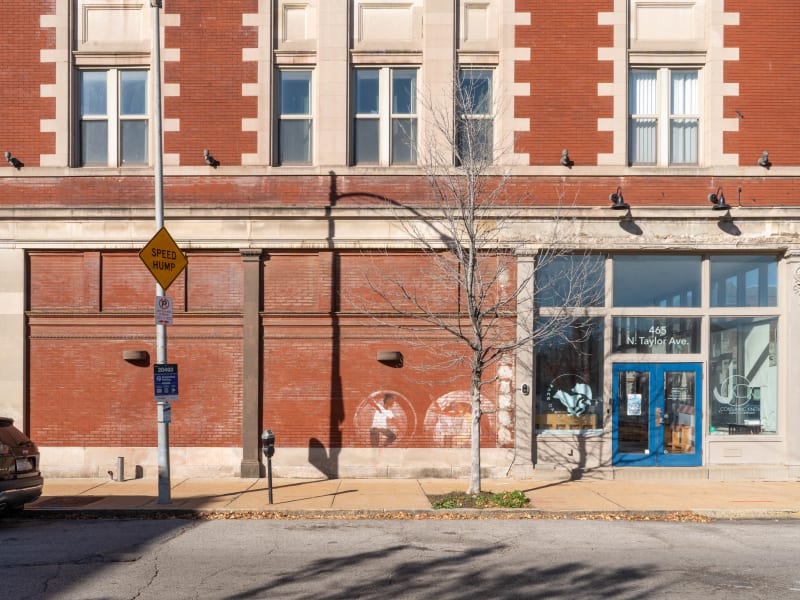
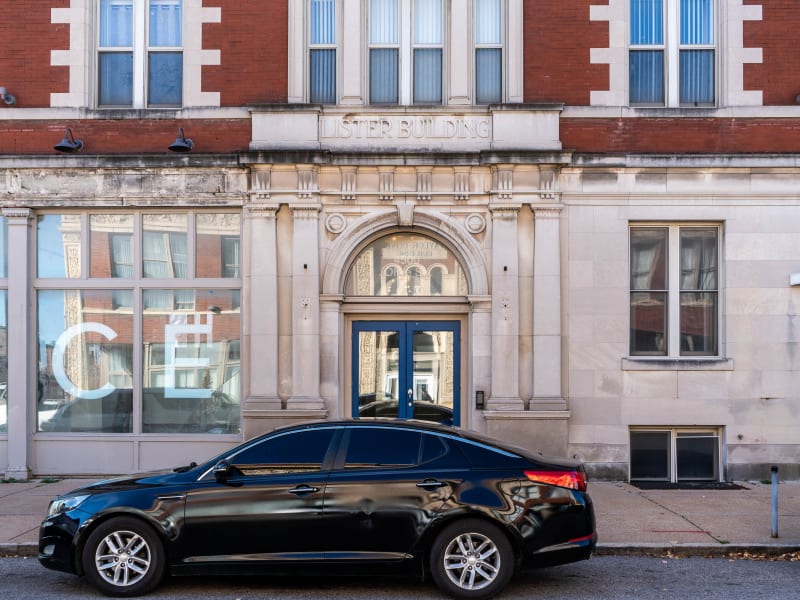
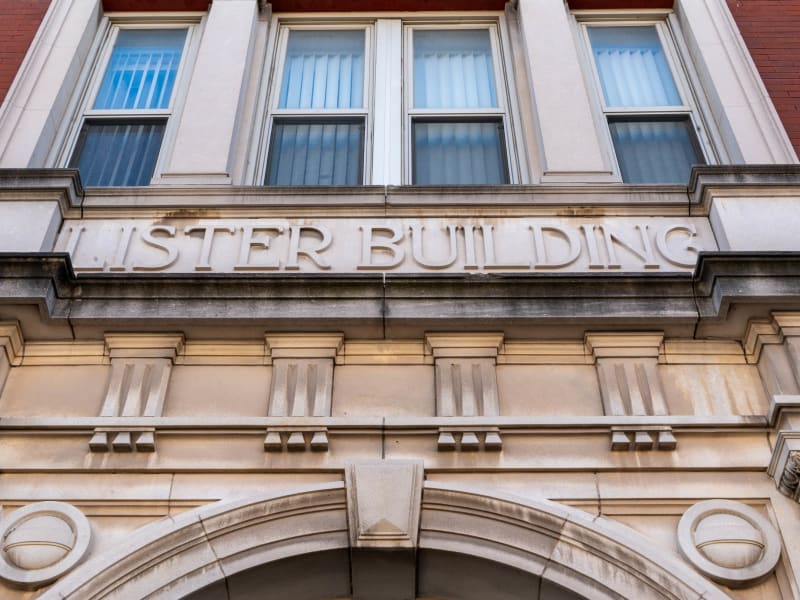
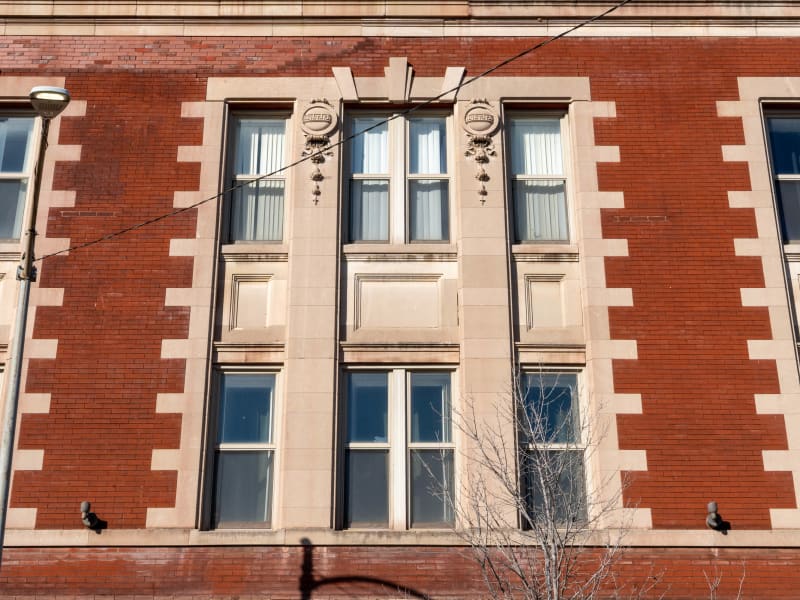
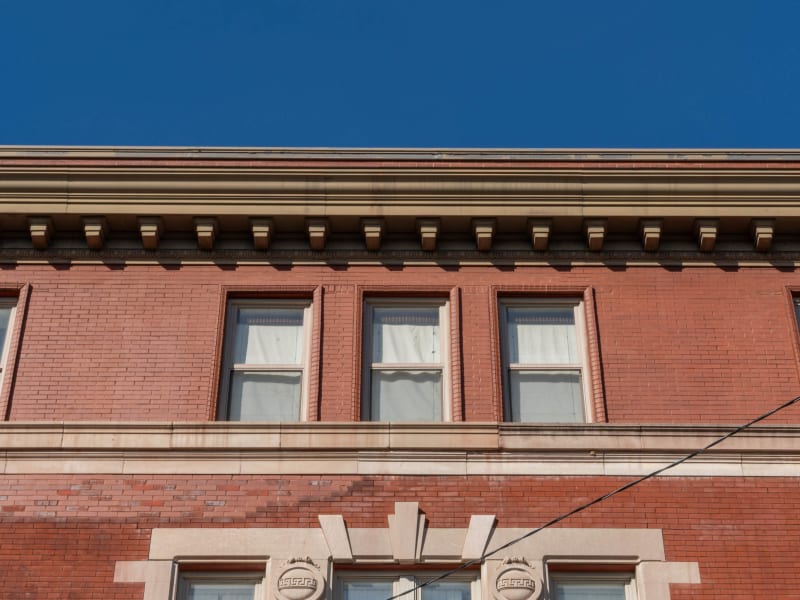
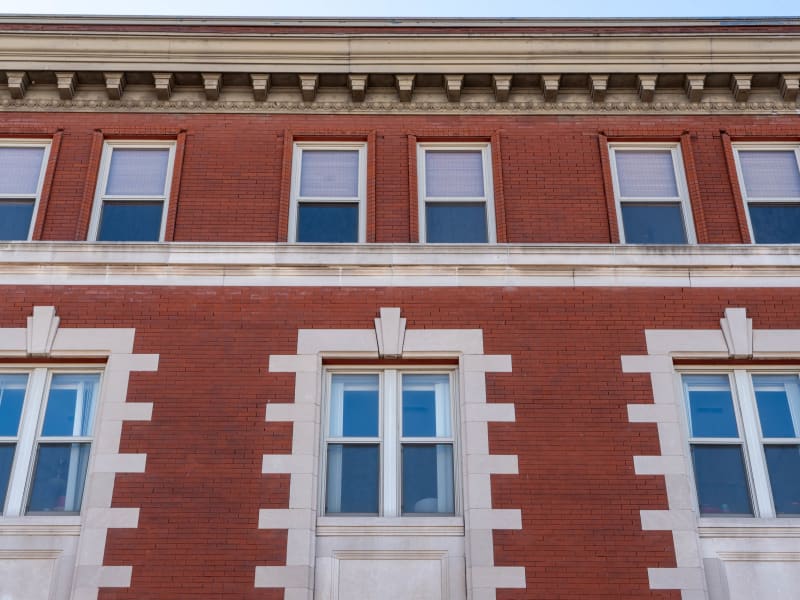
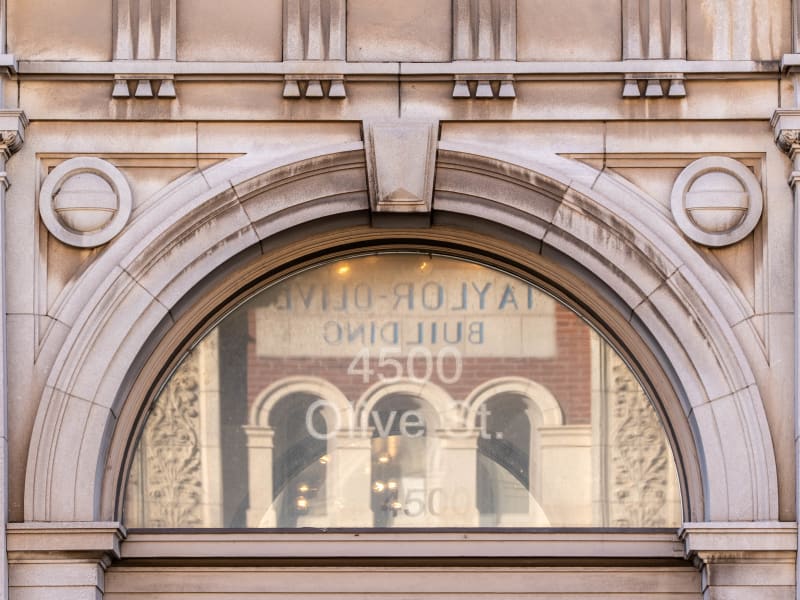
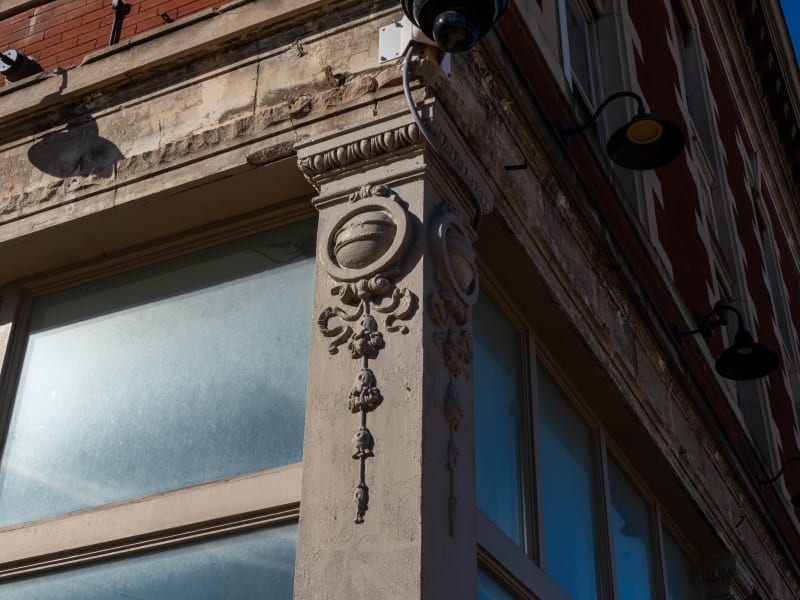
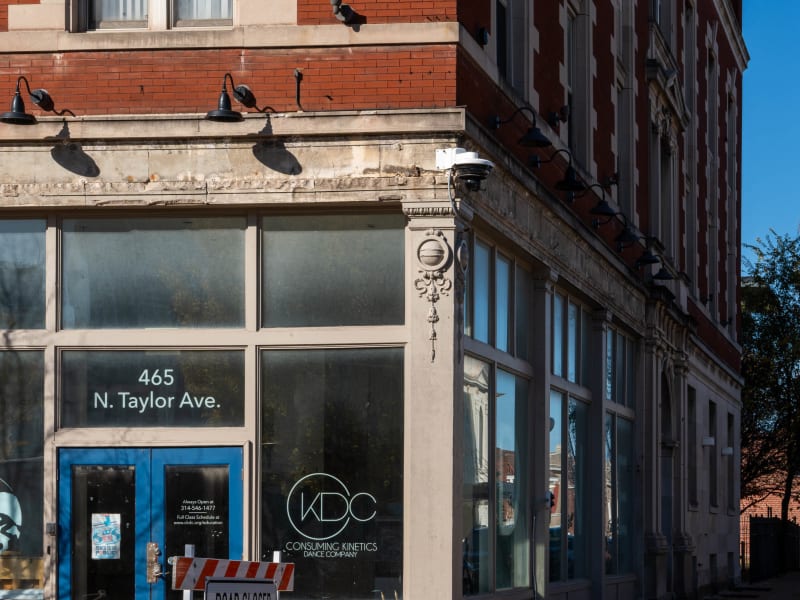
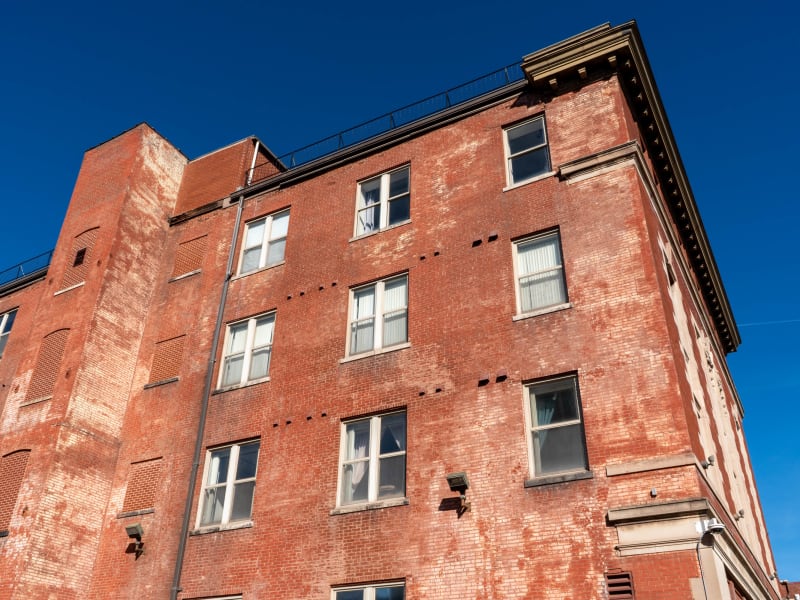
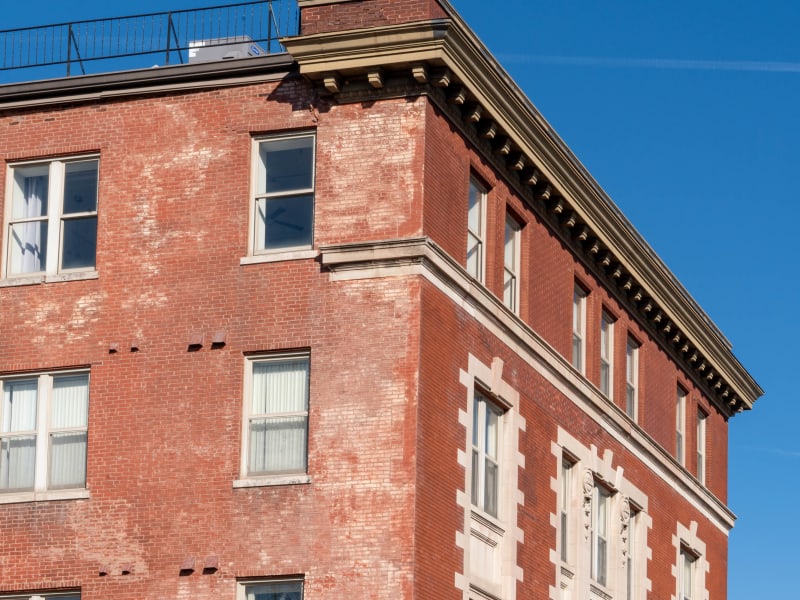
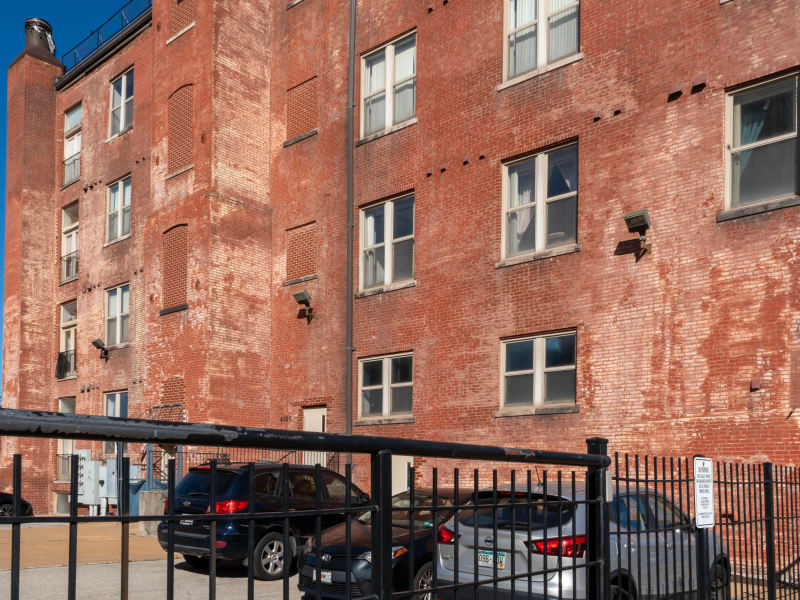
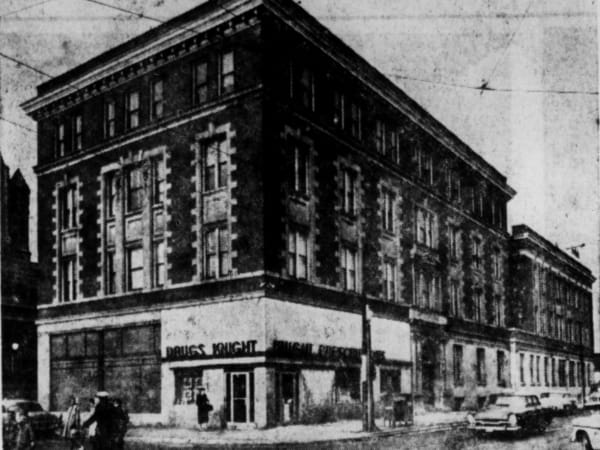
A four-story medical office building of red brick trimmed in Bedford stone, at the southwest corner of Olive Street and Taylor Avenue. John L. Wees designed it in a Renaissance-derived style. Stone quoins frame the windows, and the third-story windows have stone surrounds with discs and scrolls. A dentilled cornice runs under a plain brick parapet. The arched Olive Street entrance, flanked by paired pilasters and set with round medallions, sits under a stone panel carved LISTER BUILDING. The ground-floor storefronts were stuccoed over in 1974, and a carved scroll bracket still marks the corner. The Taylor Avenue side repeats the quoined windows, while the back walls are plain brick, patched and stepped where the wings meet. Today a dance company has the corner storefront at 465 N. Taylor. A three-story addition by Clymer & Drischler followed in 1914.
Dr. Herman Tuholske, a noted St. Louis surgeon, commissioned the building, which was completed in 1905. The National Register nomination calls it probably among the earliest major buildings in St. Louis planned especially for doctors' offices: each suite had a reception room, an examining room and a private office. The name honors either Sir Joseph Lister, the pioneer of antiseptic surgery, or Tuholske's son Lister Tuholske; the nomination does not settle which. Joseph Maserang ran a drug store on the corner from 1904 to 1942. The Landay Real Estate Company bought the building in 1911, according to the National Register nomination, and Clymer & Drischler added a three-story wing, the Lister Annex, around the corner on Taylor in 1914. A 1958 Post-Dispatch feature told the family version. Riding a streetcar past the "shiny new Lister building," young Mrs. Joseph I. Landay, wife of a wholesale furniture dealer who owned the Barwick Apartments at Kingshighway and McPherson, teased her husband that it would make a fine birthday present. A few hours later, called away from a bridge table to the phone, he told her, "It's yours. I just bought it." He had in fact already been negotiating for the building and its annex, and the deed was in her name. After his death a few years later she took over the Landay Company, sold the apartments, and ran the Lister herself for forty years, later as Mrs. Louis Posner from New York. She built a parking lot and cut a back door for patients, air-conditioned the building after the Pasteur Building across the street did, held offices for doctors who went to war, and refused every offer to sell. In February 1958 the tenants, all doctors or dentists, gave her a bronze plaque for the lobby. Doctors and dentists filled it through the 1950s, but occupancy fell to 40 percent by 1967, and by 1976 a single doctor remained. After his death it stood vacant. Pantheon Corporation bought it in 1979, and it was listed on the National Register on February 10, 1983.