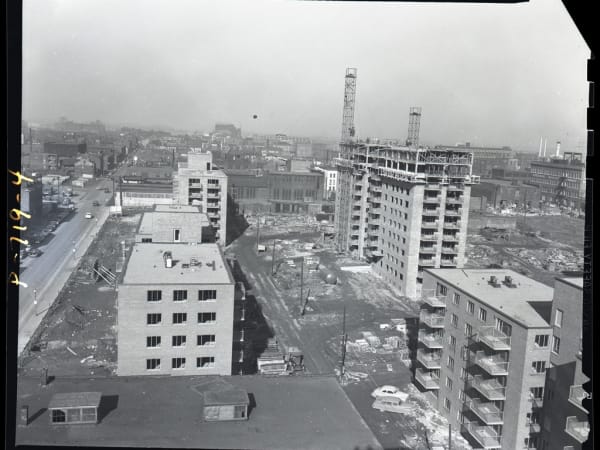
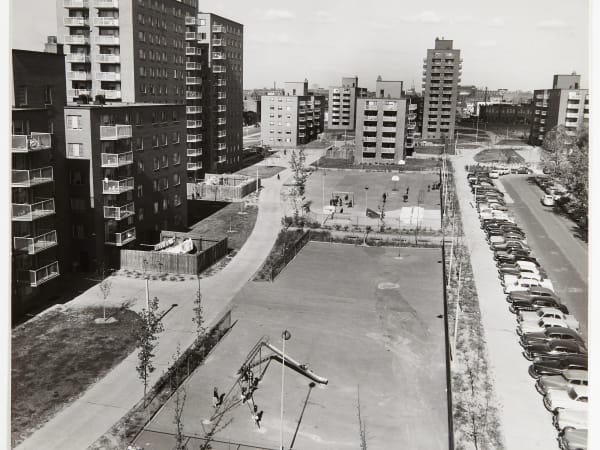
Cochran Gardens consisted of twelve high-rise apartment towers, each reaching fourteen stories, designed in the austere International Style that characterized postwar public housing. The buildings featured a stark, repetitive facade of exposed concrete and uniform window grids, with the complex arranged to create open courtyards between the towers—a modernist planning approach that prioritized density and open green space over traditional street-oriented urban fabric.
Cochran Gardens was developed by the St. Louis Housing Authority as part of the city's ambitious postwar public housing program. Completed in 1953, the complex was designed by the architectural firm Leinweber, Yamasaki & Hellmuth—the same team responsible for the nearby Pruitt-Igoe housing project. Named after John J. Cochran, a longtime Missouri congressman who championed public housing legislation during his career in Washington, the development was intended to provide modern, sanitary housing for low-income residents displaced by slum clearance efforts in the near north side. Like many public housing projects of its era, Cochran Gardens initially offered a significant improvement in living conditions for its residents. However, by the 1960s and 1970s, the complex faced many of the same challenges that plagued Pruitt-Igoe: deferred maintenance, crime, vacancy, and social isolation. In a notable departure from other troubled developments, Cochran Gardens experienced a remarkable turnaround in the 1980s under the leadership of resident activist Bertha Gilkey, who organized tenants to take control of management. The resident-led management initiative gained national attention as a model for public housing reform, bringing improved security, maintenance, and community programs to the complex. Despite these efforts, Cochran Gardens could not escape the broader policy shift away from high-rise public housing. The St. Louis Housing Authority began demolishing portions of the complex in the late 1990s as part of federal HOPE VI redevelopment initiatives. The final towers came down in 2005, ending more than fifty years of public housing on the site. The land has since been incorporated into broader neighborhood redevelopment plans for the Columbus Square area.