City Hospital No. 2
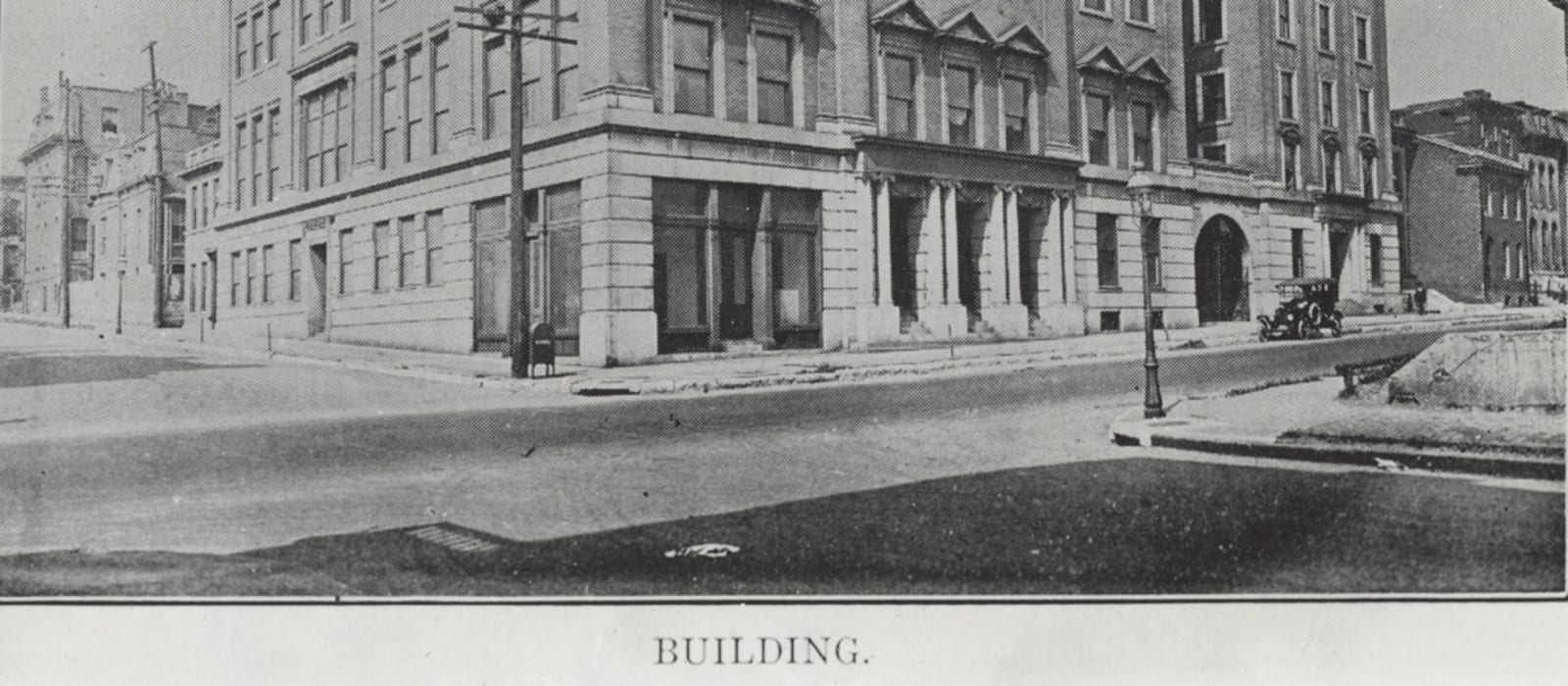
A five-story Renaissance Revival block on a corner, its rusticated stone ground floor opened by round-arched and square shopfronts and a deep-set entrance. The upper brick walls are framed by stone-quoined piers; the third-floor windows carry alternating triangular and segmental pediments, and the top floor sits in recessed panels beneath a bracketed, modillioned cornice and a paneled parapet. Carved console brackets mark the canted corner. The whole is symmetrical and heavily trimmed in stone, in the manner of an 1890s commercial building.
Barnes Medical College was organized in 1892 and named for Robert A. Barnes, a St. Louis merchant and banker who died that year; the school hoped for support from his estate but never received it. Its first building stood at 2645 Chestnut Street, later renamed Lawton. In 1896 the college opened this five-story building two blocks west, at the northeast corner of Lawton and Garrison Avenue. In 1902 Centenary Hospital and the Barnes Dispensary opened in a new building adjoining the college as its clinical facility; Christian Hospital administered Centenary from about 1911 to 1914. In 1909 Abraham Flexner, surveying American medical schools, called the arrangement of the Barnes buildings "shockingly bad." The college merged with the American Medical College in 1912 to form National University, which the St. Louis College of Physicians and Surgeons joined in 1915; its last medical students graduated in 1918. From 1919 to 1936 the City of St. Louis used the Centenary building as City Hospital No. 2, the municipal hospital for Black St. Louisans under segregation, with about 177 beds. From 1922 the attorney Homer G. Phillips campaigned for a larger facility, and Homer G. Phillips Hospital opened in the Ville in 1937. The buildings at Lawton and Garrison were demolished in 1960 during the Mill Creek Valley clearance.


