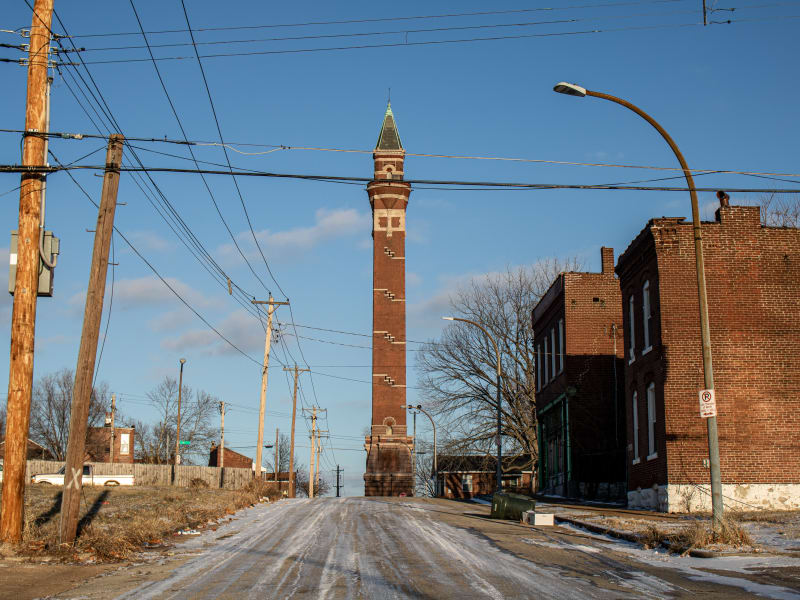
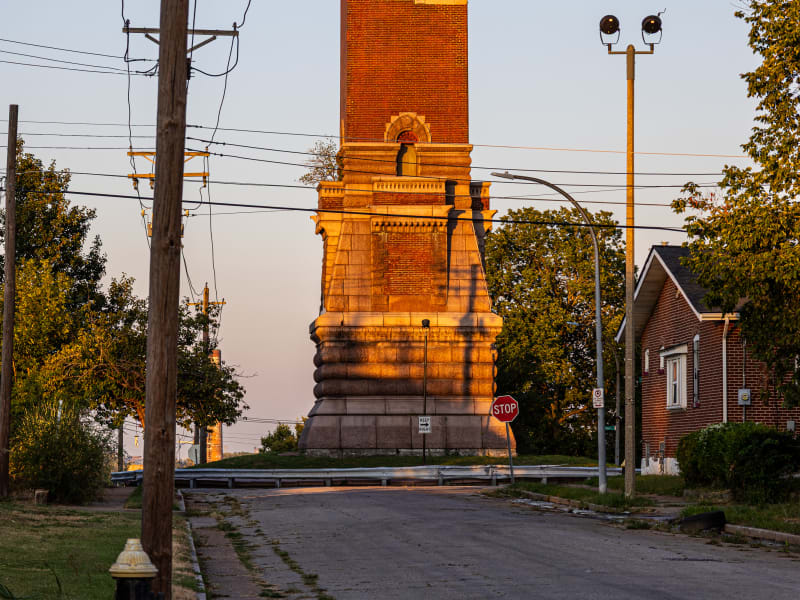
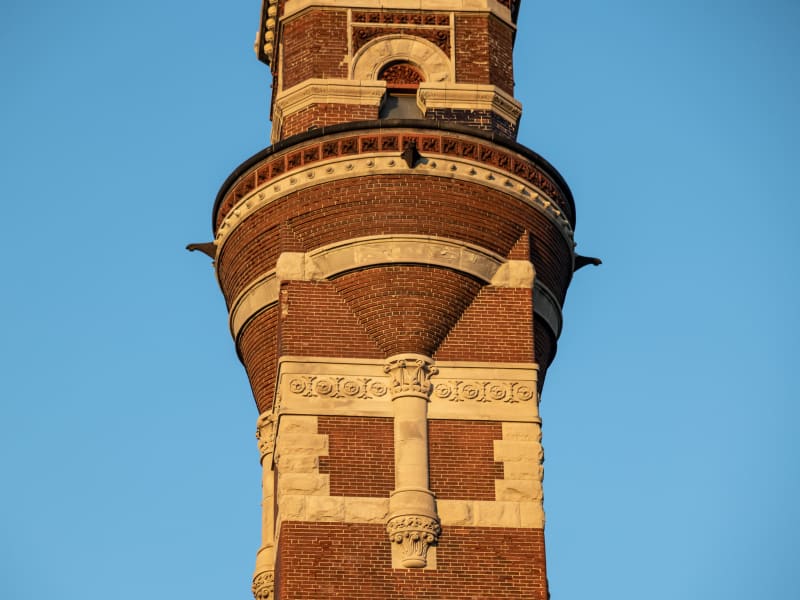
The Bissell Street Water Tower is a striking Romanesque Revival structure featuring a tall cylindrical brick shaft encircled by decorative terra cotta banding and topped with a conical roof crowned by an ornamental finial. Rising approximately 195 feet, the tower's ornate cornice, arched openings, and richly textured masonry make it one of the most visually distinctive landmarks in North St. Louis.
The Bissell Street Water Tower was constructed in 1885 as part of St. Louis's expanding municipal water system, designed to regulate water pressure for the rapidly growing neighborhoods of North St. Louis. Architect William S. Eames, who would later design the similar Compton Hill Water Tower, was commissioned to create a structure that would serve this essential civic function while also contributing to the city's architectural character. The tower was built to house a standpipe that helped equalize pressure in the water distribution system, addressing the challenges of delivering reliable water service across the city's varied topography. Throughout the late nineteenth and early twentieth centuries, the tower served its intended purpose as a critical piece of urban infrastructure. The College Hill neighborhood surrounding the tower developed as a prosperous residential area, and the water tower became a familiar landmark for generations of North St. Louis residents. Like many standpipe towers of its era, the Bissell Street Water Tower eventually became obsolete as water system technology advanced, and it was decommissioned from active service. The tower was recognized for its historical and architectural significance with a listing on the National Register of Historic Places in 1972, joining the Compton Hill Water Tower as one of only a handful of surviving ornamental water towers in the United States. Today, the Bissell Street Water Tower stands as a monument to St. Louis's nineteenth-century investment in public infrastructure and remains a prominent landmark in the College Hill neighborhood, though it no longer serves any functional water system purpose.