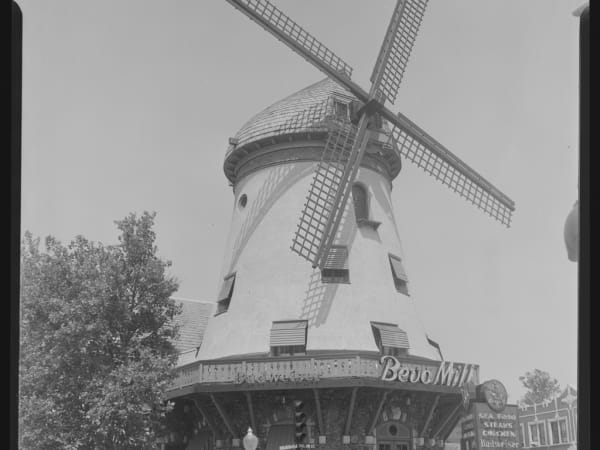
A restaurant built around a full-size Dutch windmill. The tapering mill tower, painted white, rises from a base of rough fieldstone pierced by tall round-headed windows with green frames. A wooden gallery wraps the tower above the base, carried on angled timber braces, and the tower ends in a dark rounded cap with four lattice sails turning over the corner. Behind it stretches a lower wing in a Tudor manner, with steep gabled roofs, dormers, tall chimneys and walls of the same fieldstone.
Adolphus Busch had imagined a family restaurant in the shape of a Dutch mill, but he died in 1913 before plans were drawn, and his son August Busch built it. Construction began in 1916 on the site of a blacksmith shop, to a design by Klipstein and Rathmann, and the Bevo Mill opened on June 19, 1917, at a cost of about $200,000. Busch ran it as a German-style saloon with no bar, serving beer, light wine and soft drinks, and named it for Bevo, the near-beer Anheuser-Busch was then brewing. Anheuser-Busch kept the building and leased the restaurant to a run of operators. Carl Henry Dietz managed it from 1917, bought the business in 1920 and ran it until 1931. Arthur B. Schneithorst reopened it on July 26, 1939, renovated and air-conditioned, with the Holland Dining Room on the main floor and the Yacht Club lounge in the basement. His widow, Bertha, ran it after his death in 1947, and Collins Enterprises bought the restaurant in 1959. The city named the mill City Landmark No. 36 in 1971. The restaurant closed in July 1984 and reopened in April 1986 after Anheuser-Busch spent $1 million on restoration. Anheuser-Busch later gave the property to the city, and the St. Louis Development Corporation took ownership in January 2009, two months before the restaurant closed again. Pat and Carol Schuchard bought the building and reopened it in 2017 as Das Bevo Bierhall.