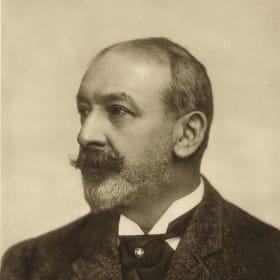
Theodore C. Link
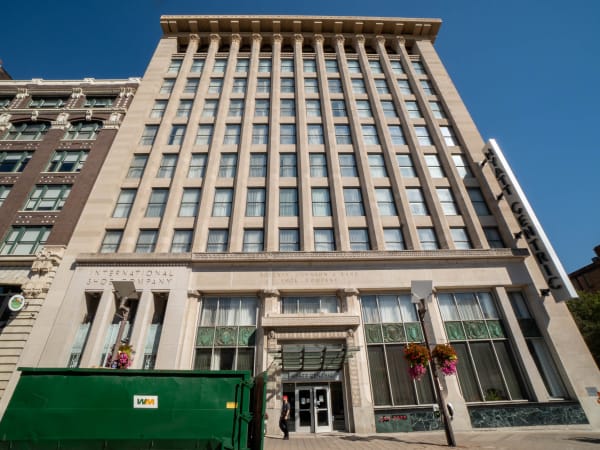
Theodore C. Link (1850-1923) was born near Heidelberg, Germany, on March 17, 1850, and trained as an engineer at the University of Heidelberg and the Ecole Centrale in Paris. He came to the United States in 1870 and worked for railroads in New York, Philadelphia and Texas before arriving in St. Louis in 1874 with the Atlantic and Pacific Railroad. The next year he drew up the plans for Forest Park designed by Julius Pitzman and Max Kern, and on Pitzman's recommendation he served as the city's Superintendent of Parks in 1876 and 1877. He married Annie Fuller of Detroit, then spent about four years in Pittsburgh publishing two German-language newspapers. Link came back to St. Louis in 1882 and opened a civil engineering office, and by 1886 he was listed in the city directory as an architect. In 1891, with Edward Cameron, he won the competition for Union Station, which opened in 1894 and became his best-known work. He was briefly in partnership with Alfred F. Rosenheim and William B. Ittner in the mid-1890s, and with his son Carl from 1910 to 1912, but for most of his career he practiced under his own name. His St. Louis work takes in churches, institutions, houses and commercial buildings: the entrance gates of Westmoreland and Portland Places, Second Presbyterian Church (1899), St. John's Methodist Church (1901), the Barr Branch Library (1905), the first Carnegie library built in the city, the Wednesday Club (1908), the Oscar Johnson house on Portland Place (1908), and the Roberts, Johnson & Rand Shoe Company Building on Washington Avenue (1909), later the headquarters of International Shoe. Beyond the city he designed the Mississippi State Capitol in Jackson (1903). For the 1904 World's Fair he sat on the Committee of Architecture and designed the Palace of Mines and Metallurgy and the Mississippi State Building. He was elected to the national board of the American Institute of Architects in 1899. In 1919 Link and Wilbur T. Trueblood began the master plan and the first buildings for Louisiana State University's new campus in Baton Rouge. Link died there on November 12, 1923, with the work still under way, and was buried in Bellefontaine Cemetery.